
Despite the fact that ammonia is traditionally known for its high toxicity and potential health hazards in the event of an leak, recent developments have significantly reduced its content in refrigeration systems, improving their safety. These systems are known as "low-ammonia systems."
Essentially, a small ammonia charge means reducing the amount of refrigerant used in the refrigeration cycle.
Leading US industry organizations, such as the Global Cold Chain Alliance (GCCA), the International Association of Refrigerated Warehouses (IARW), and the International Association of Cold Storage Construction (IACSC), identify three main types of "small-scale refrigeration" technologies:
Advanced traditional systems that use improved control systems or specialized evaporators to minimize the amount of ammonia used; Compact systems that are often installed on the roof of buildings; and Combined systems that use CO2 and NH3 together to reduce refilling.
These low-ammonia technologies are used in various industries, including the food industry, food storage, data centers, pharmaceutical manufacturing, as well as in supermarkets and commercial building air conditioning systems.
Traditional ammonia system.
A classic ammonia refrigeration system uses a significant amount of ammonia, over 4,536 kg, often in combination with a glycol circuit, forming a so-called centralized system. This system provides power for air conditioners, air coolers, and other equipment located throughout the facility. The main components, such as compressors, condensers, and tanks, are located in a central machine room, from where the ammonia is distributed to the consumers.

Small ammonia refill system: an optimized version.
The optimized low-charge ammonia refrigeration system is based on traditional industrial refrigeration technology, with additional optimization through the use of reduced-volume ammonia components, such as specially designed evaporators, control systems, heat exchangers, compressors, and condensers. A properly designed optimized low-charge system uses less than 2746 kg of ammonia, which allows for smaller tank sizes, reduced pipe count and diameter, and the elimination of pumps. However, a machine room is still necessary.
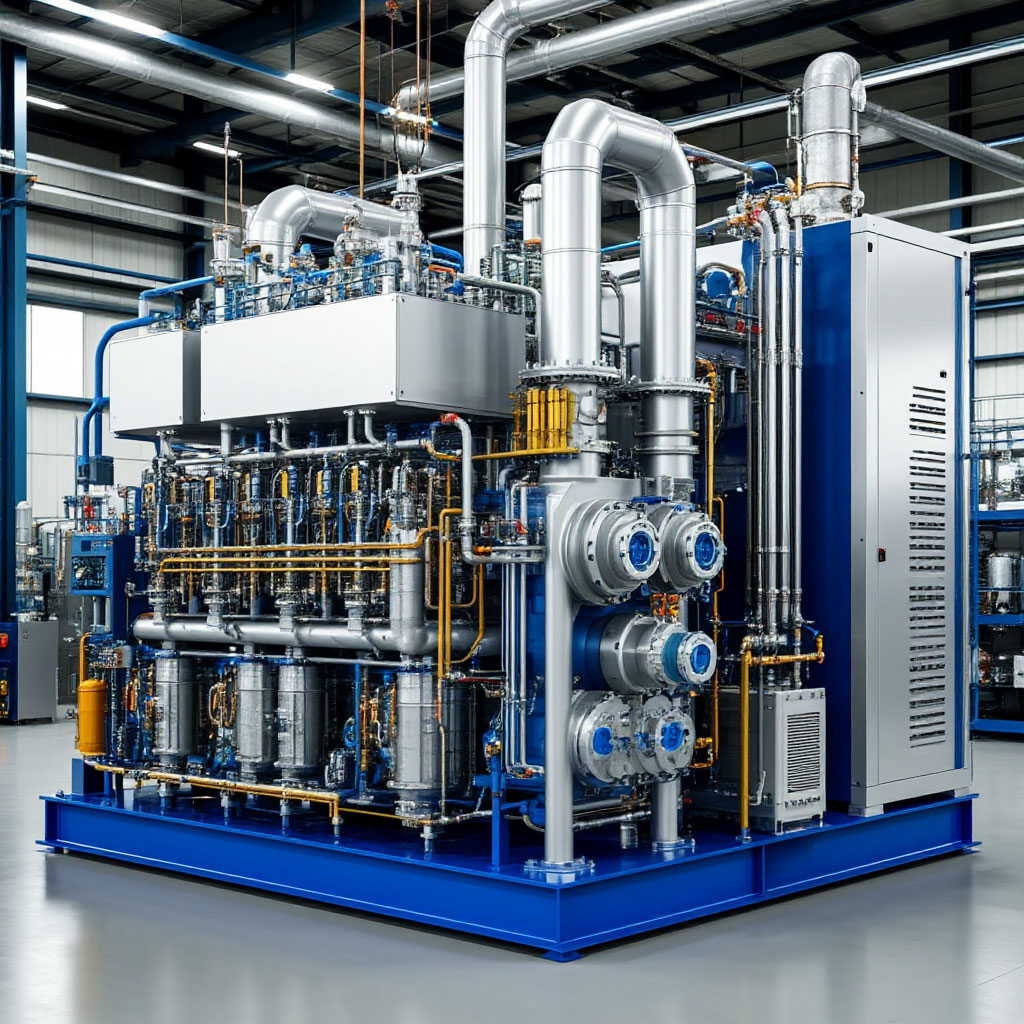
Small-scale ammonia system: a decentralized option.
A compact ammonia system avoids large ammonia stocks and an extensive piping network by moving to small stand-alone systems, which are typically installed on the roof or on the ground outside the building, thereby eliminating the risk of leakage. These stand-alone systems have an ammonia charge capacity of about 0.55 kg/kW and typically integrate the compressor, evaporator valve system, and control systems into a single, easily assembled, and mobile modular design.

Low-ammonia system: NH3/CO2 system.
The ammonia/CO2 system can be implemented in various configurations (e.g., cascade, CO2/NH3 with brine, and a DX system with ammonia that uses a circulating liquid CO2 supply), but the basic principle is to isolate the ammonia circuit, which typically ranges from 0.5 to 0.83 kg/kW, in the engine room and use CO2 as a secondary coolant that can be supplied to the refrigeration chambers on-site. Such a system may require additional CO2 transfer equipment, as well as additional compressors and other components for the CO2 side.
Need for definition.
Experts agree that in order to further stimulate innovation in low-ammonia-loading systems and develop technologies for the HVAC (heating, ventilation, and air conditioning) market, as well as to improve food safety and the safety of refrigeration industry workers, it is necessary to clearly define what is meant by the term "low-ammonia-loading".
Any definition should reflect the safety, reliability, and efficiency of a low-fill system by indicating the amount of ammonia it contains in kg/kW.
The agreed definition will help accelerate the transition to low-filling technologies, provide access to high-quality technical information, and allow the industry to apply less stringent regulations and guidelines when working with ammonia.




In December 2025, Copeland—a global leader in compressor manufacturing—unveiled a new development: a CO₂ scroll compressor featuring Dynamic Vapor Injection (DVI) technology. This milestone marked a significant step in the evolution of industrial refrigeration equipment, as the combination of the natural refrigerant CO₂ and an advanced vapor injection system opens up new possibilities for enhancing energy efficiency, reducing operating costs, and meeting environmental regulations.
 Выберите размер контейнера: Температурный режим: Новый или Б/У: | Прайс-лист на рефрижераторные контейнеры Вы выбрали: 40 футовые, низкотемпературные, новые 
| ||||||||||||||||||||||||||||||||||||||||||||||||||||




 Telegram

