
By 2030, the Don region is expected to have the largest modern logistics center in the south of Russia. The project, which is being implemented as a pilot project in collaboration with the Nizhny Novgorod region, has already received federal support. According to First Deputy Governor Alexey Gospodarev, the authorities are working with experts to analyze cargo flows in order to determine the optimal locations for the complexes. The goal is not just to increase the export of raw materials, but also to develop the deep processing of agricultural products and aquaculture, and create high-value-added goods. Modern logistics complexes offering a full range of services are already fully loaded, and they are being actively expanded.
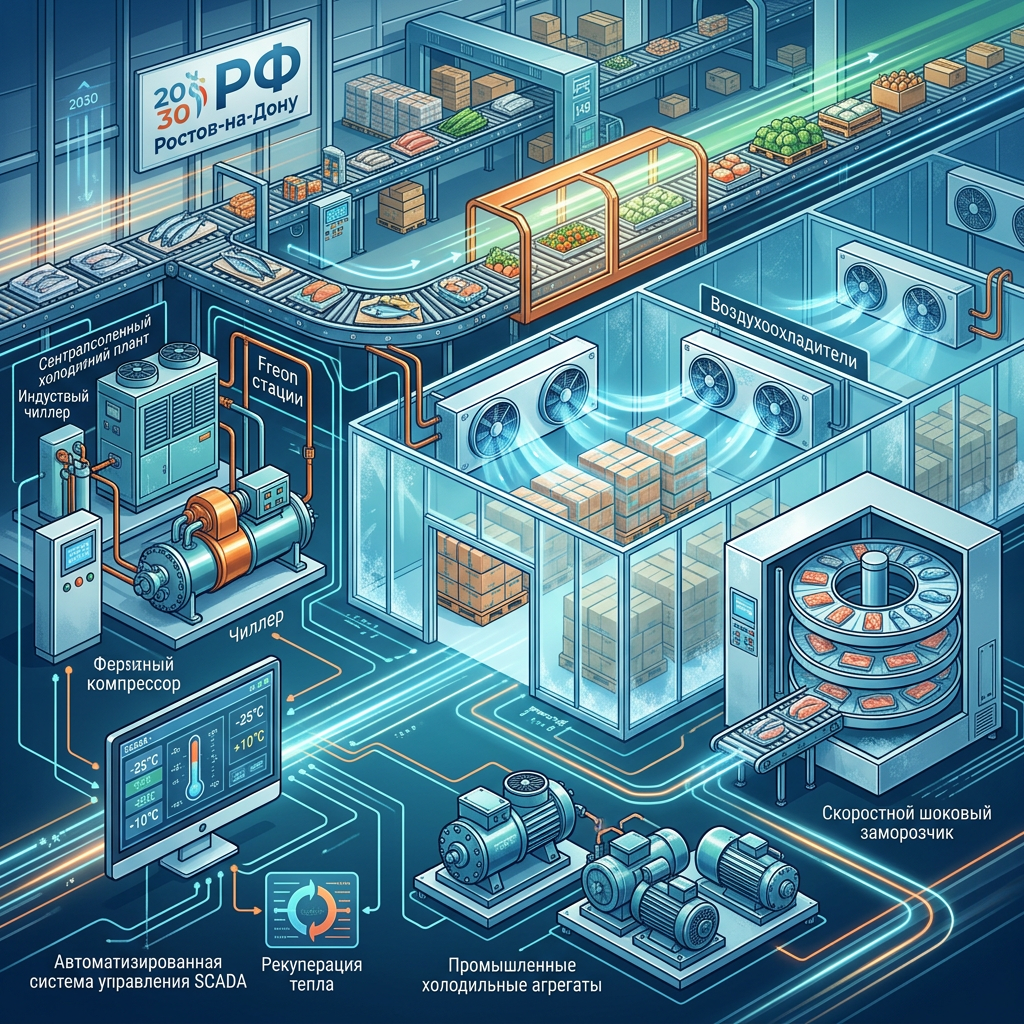
For companies specializing in industrial refrigeration equipment, the construction of such a hub opens up significant opportunities. A large-scale center will inevitably require an extensive system for storing perishable goods, ranging from fresh fish and meat to frozen semi-finished products, vegetables, and fruits. Industrial refrigeration equipment will play a crucial role in ensuring the continuity of logistics chains and the preservation of high-value products.
Let's explore the types of industrial refrigeration equipment that will be required for this project, their functions, and applications.
1. Central refrigeration units (chillers) and freon stations
This is the heart of the system. Chillers are designed to cool the liquid coolant (water or glycol), which is then circulated through the air coolers in the chambers. Large logistics centers use screw and centrifugal chillers. Their functions are to maintain a stable temperature in large storage areas (from -25°C to +10°C) with high energy efficiency. Applications include creating a single refrigeration system for dozens of freezer and refrigeration chambers and ensuring the operation of refrigerant systems spread over large areas. Specifications: cooling capacity from 100 kW to several MW, use of ozone-friendly refrigerants (R-134a, R-507, R-404A), and the ability to cascade for temperatures up to -40°C.
2. Industrial refrigeration units with screw and piston compressors
Standalone units that are either built into refrigeration chambers or mounted on separate platforms. Screw compressors (Bitzer, Mycom, Frascold) are preferred for capacities of 50 kW and above, as they provide high reliability and smooth performance control. Piston compressors (Bitzer, Carlyle) are suitable for medium loads up to 50 kW, offering lower initial costs and easier maintenance. Functions: direct air cooling in storage or freezing chambers. Application: maintain the set temperature in separate compartments: freezing chambers (-18°C…-25°C), cooling chambers (+2°C…+6°C), and defrosting chambers. Characteristics: high degree of automation, use of ammonia or freons, and the ability to defrost with hot gas.
3. Air cooling systems — air coolers (Evaporators)
They are installed inside storage facilities and are responsible for removing heat from the product. Large hubs use floor-standing and suspended air coolers with axial fans. Functions: even distribution of cold air, prevention of frost on the evaporator, and maintaining the desired humidity level. Applications: for meat and fish, low-temperature models with heated drainage; for vegetables and fruits, models with high air exchange rates to prevent wilting. Specifications: heat exchanger fin pitch from 6 mm (low-temperature) to 12 mm, material: aluminum or stainless steel, electronic expansion valve (TEV).
4. High-speed shock coolers (spiral, tunnel, fluidization)
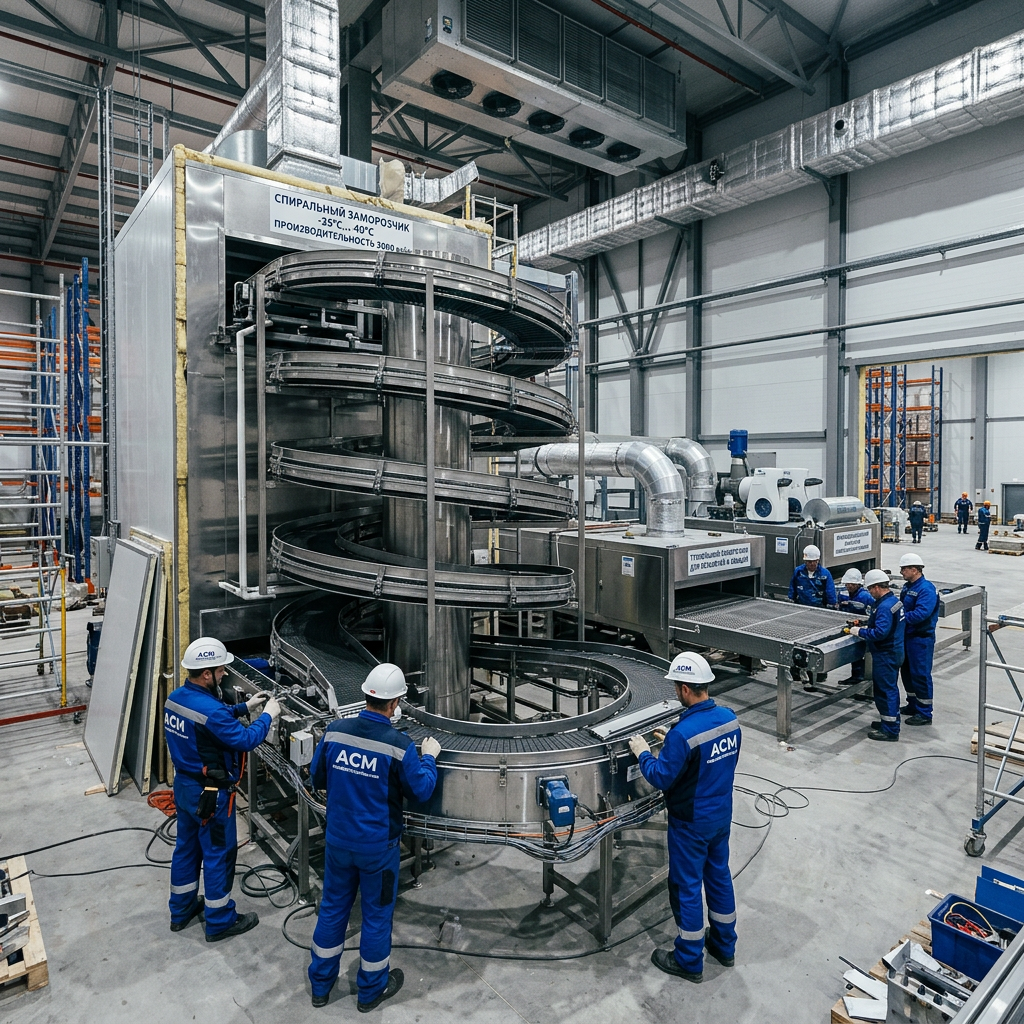
For processing products with high added value (ice cream, dumplings, and vegetable mixtures). Spiral freezers are continuous belt conveyors where the product passes through a -30°C to -40°C temperature zone. Functions: rapid freezing in the flow, minimizing moisture loss, and preserving the product's structure. Applications: in the deep processing of meat, fish, and poultry within the hub. Specifications: capacity from 500 to 3000 kg/h, belt length up to 50 m, use of a defrosting system, and a stainless steel body.
5. Automated control systems (SCADA) and heat recovery
Comprehensive control of a refrigeration unit with remote monitoring. Functions: automatic temperature, humidity, and defrosting control, alarm notifications, and energy consumption graphs. Applications: integration with a warehouse WMS system and optimization of operating modes. The recuperation system utilizes heat from condensers for heating warehouses or preparing hot water. Features: full parameter control, remote access, data archiving, and a load forecasting module.
Why will the construction of a hub be a significant growth driver for industrial refrigeration companies? First, the required capacity will be comparable to that of the largest agro-industrial complexes. This includes hundreds of kilowatts of refrigeration and thousands of square meters of freezing chambers. Second, the focus will be on providing turnkey solutions rather than just equipment. This includes design, installation, commissioning, and service. Thirdly, the focus on deep processing (aquaculture, agricultural products) requires equipment not only for storage, but also for shock freezing, which is a premium segment of the market.
Thus, the largest logistics center in the South will become a point of attraction for suppliers of industrial refrigeration equipment. Companies that can offer energy-efficient multi-temperature solutions based on modern chillers, screw units, and automation systems will receive long-term contracts, and the hub itself will provide a reliable infrastructure for the movement of goods.




In December 2025, Copeland—a global leader in compressor manufacturing—unveiled a new development: a CO₂ scroll compressor featuring Dynamic Vapor Injection (DVI) technology. This milestone marked a significant step in the evolution of industrial refrigeration equipment, as the combination of the natural refrigerant CO₂ and an advanced vapor injection system opens up new possibilities for enhancing energy efficiency, reducing operating costs, and meeting environmental regulations.
 Выберите размер контейнера: Температурный режим: Новый или Б/У: | Прайс-лист на рефрижераторные контейнеры Вы выбрали: 40 футовые, низкотемпературные, новые 
| ||||||||||||||||||||||||||||||||||||||||||||||||||||




 Telegram

