
In Bashkiria, the active development of digital infrastructure continues. The company Sintora has become a resident of the advanced development territory “Blagoveshchensk” and has begun building a data processing center with an investment of 180 million rubles. This is already the second data center in Blagoveshchensk, and its launch is scheduled for the fourth quarter of 2026, with full capacity reached in 2027. For the region, this is an event of strategic importance: the stability of businesses, government services, and entire industries today directly depends on the reliability of information storage and processing. However, behind the seemingly “harmless” facade of server rooms lies a highly complex engineering system, in which industrial refrigeration equipment plays one of the key roles. It is this equipment that ensures the physical operability of the electronics, without which any data center turns into a pile of useless metal.
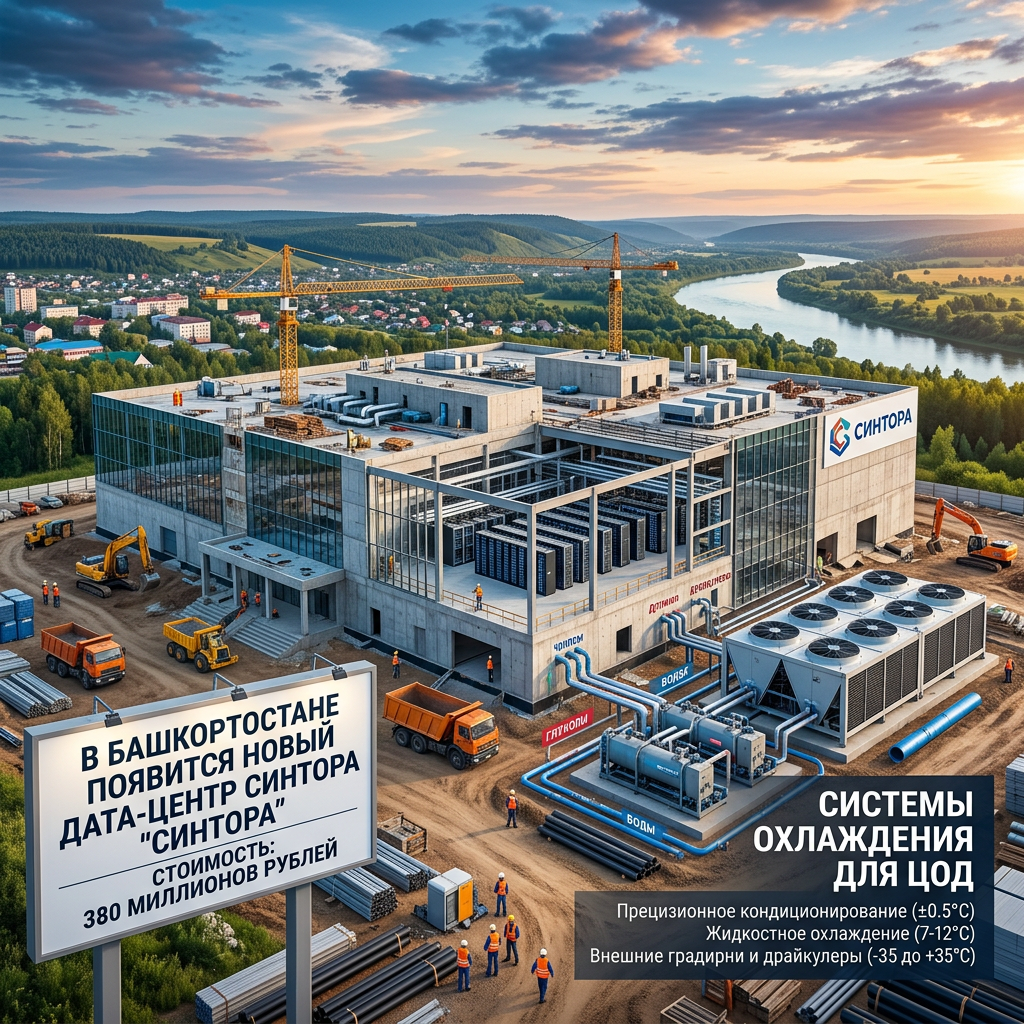
Servers operating around the clock generate a colossal amount of heat. Even with a moderate density of racks, the temperature inside the room can quickly exceed the permissible limits, which leads to overheating of processors, equipment malfunctions, and, in the worst‑case scenario, to fires. For data centers of the “Synthors” level, the permissible temperature range is usually from 18 to 27 degrees Celsius, while the humidity must be maintained within 40–55%. A deviation from these parameters by a few degrees already creates a risk of electronic component degradation. Therefore, the cooling system is not just a “fan,” but a full‑fledged engineering complex that must operate flawlessly. In the conditions of the Bashkir climate, where the air temperature can reach +35 degrees in summer and drop to -30 in winter, the design and selection of refrigeration equipment require special attention.
For companies engaged in the field of industrial refrigeration equipment, such projects become an important customer. The supply, installation, and maintenance of cooling systems for data centers represent a separate niche with high requirements for accuracy, reliability, and energy efficiency. The construction of a second data center in Blagoveshchensk creates a steady demand for such solutions, which stimulates the development of local manufacturers and service organizations.
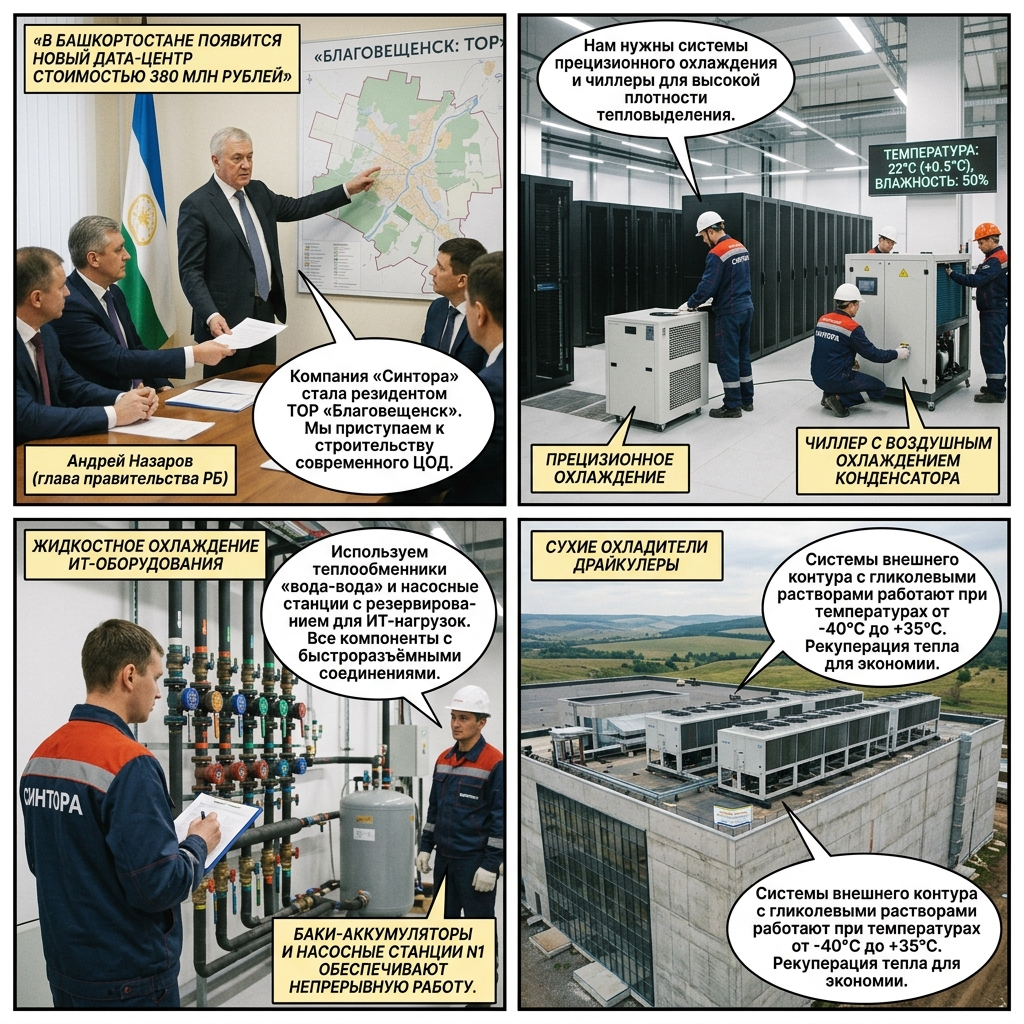
Let’s take a closer look at the specific systems used in such projects, their characteristics, and functions.
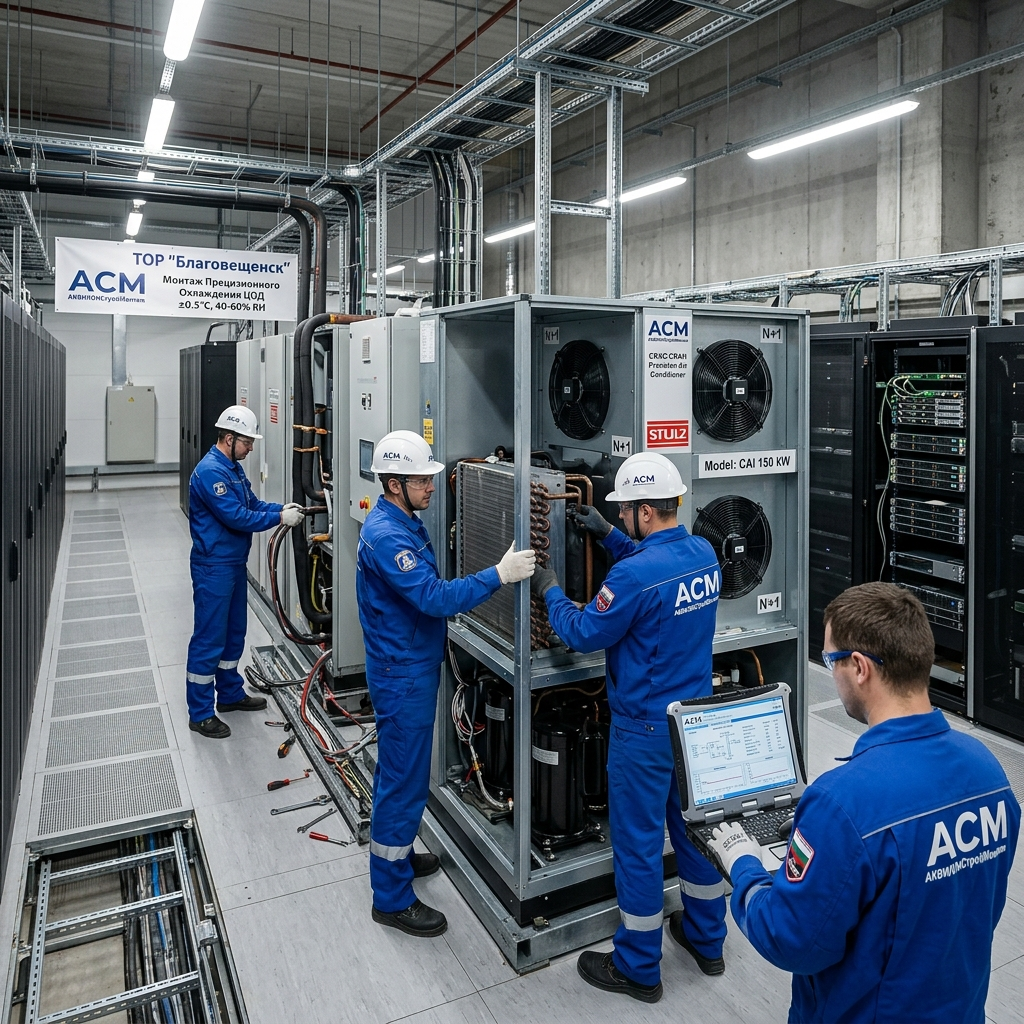
This is the heart of cooling in any server room. Precision air conditioners ensure precise maintenance of temperature and humidity with an error of no more than 0.5 degrees. Unlike household models, they are designed to operate 24/7 under conditions of high thermal load. Their power ranges from 10 to 100 kW or more, and freons with low global warming potential are often used as refrigerants. The main functions are air cooling, dust filtration, and humidity control. The Sintory data center will require both wall‑mounted and floor‑standing monoblock or rack‑mounted models, integrated into a single network with automatic switching in case of a failure of one of the units.
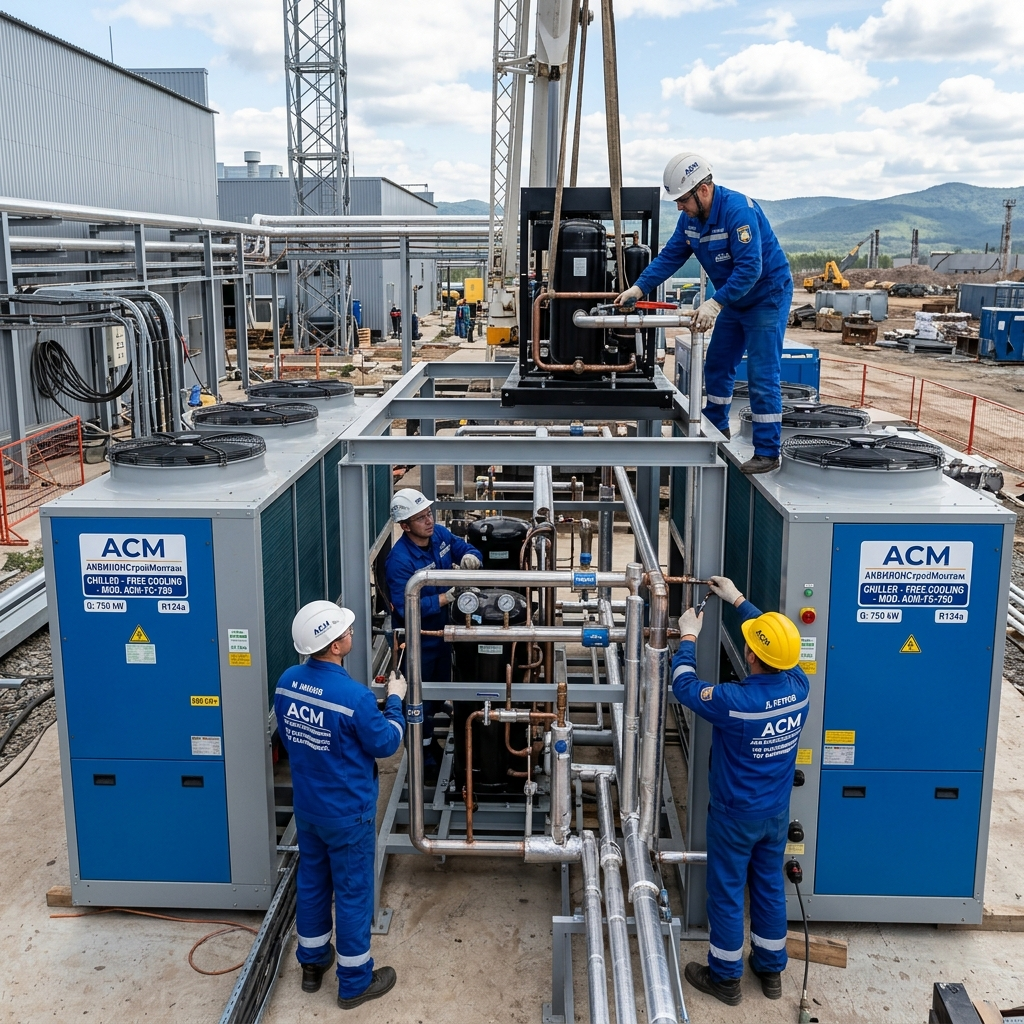
If precision air conditioners cool the air directly, then chillers work in conjunction with fan coils or other heat exchangers. The chiller produces cold water (usually at a temperature of 7–12 degrees), which circulates through the circuit and removes heat from the air in the room. The capacity of chillers for an average data center ranges from 200 to 2000 kW. Their advantage is the possibility of remote placement outdoors or on the roof, which saves space inside the building. For Bashkiria, it is important to choose chillers with air‑cooled condensers so as not to depend on water shortages, as well as those with frequency control of compressors — this reduces energy consumption by 20–30 %. At the “Sintory” facility, it is planned to use at least two chillers with redundancy according to the N+1 scheme.
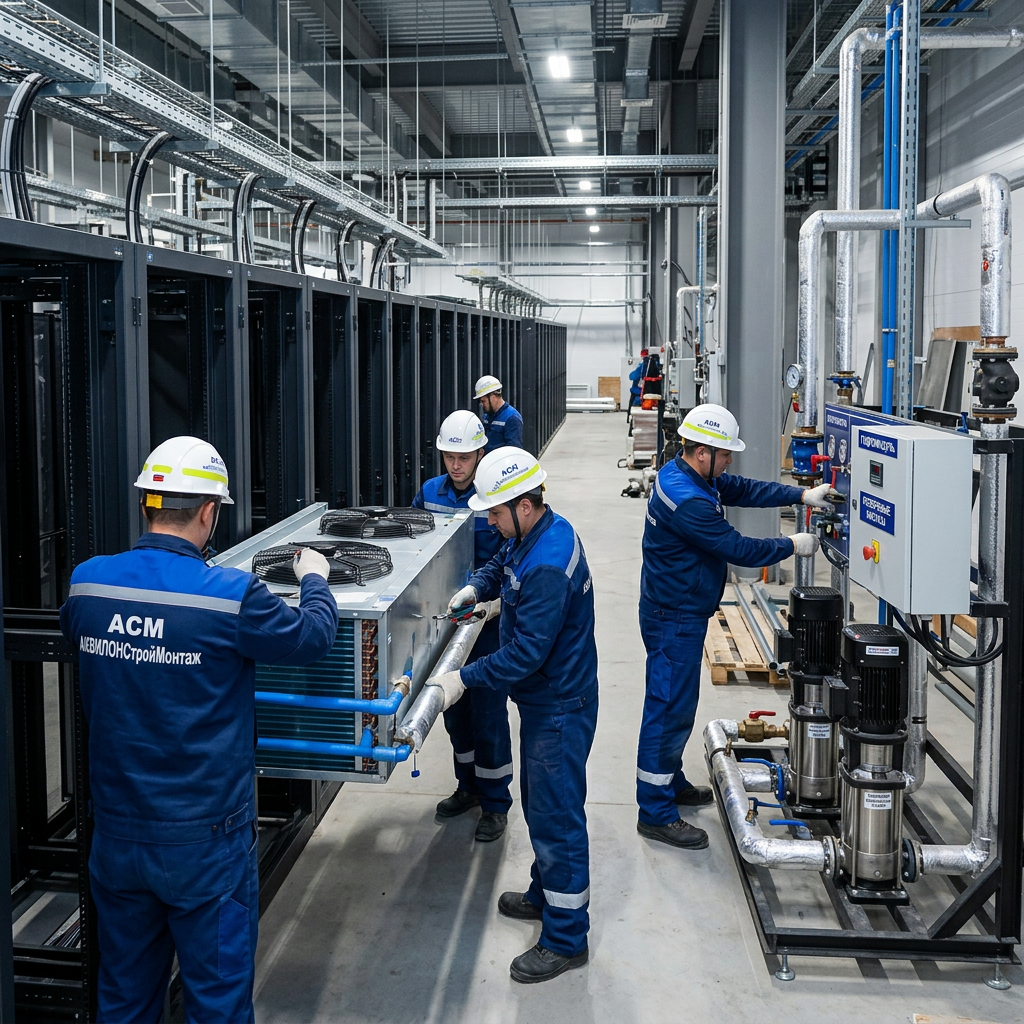
Fan coils are internal units through which cold water flows, and a fan blows air over them. They are installed in server rooms, sometimes right in the rows of racks. Hydromodules are pumping stations that ensure water circulation in the circuit. For large data centers, fan coils with a horizontal or vertical design are used, with a cooling capacity of 3 to 15 kW each. Hydromodules must have backup pumps and automatic activation in the event of an emergency. In the case of “Sintor,” with its planned full capacity in 2027, a hydraulic system with a throughput capacity of at least 50 cubic meters of water per hour will be required.
An economically justified solution for regions with a temperate climate. During the cold season, when the outdoor air temperature is below 10 degrees, the system automatically switches to directly using external air for cooling, bypassing the compressor cycle. This reduces energy consumption by 40–70% during the winter period. For Bashkiria, where winter lasts about 5 months, free cooling is especially relevant. Such systems use air dryers and highly efficient filters to prevent dust and moisture from entering the server rooms. The power of such units can reach 500 kW or more, and they have low noise and vibration levels.
These are specialized cabinets that are placed between server racks. They provide targeted cooling of hot zones by directing cold air directly to the front part of the servers. The efficiency of such systems is up to 95% of the cooling capacity, as there are no losses due to air mixing. The specifications vary: the width is usually 600 mm, the height is 2000 mm, and the cooling capacity ranges from 10 to 50 kW per unit. They are ideal for racks with a high equipment density, which is typical for modern data centers, including the “Sintory” facility. The in‑row coolers are equipped with their own variable‑speed fans and temperature sensors, which allows them to adapt to the load in real time.
For regions with hot summers and low humidity, adiabatic humidifiers are used, which work in tandem with air conditioners. The operating principle is the evaporation of water in the air flow, which reduces the temperature by several degrees. This allows reducing the compressor power by 15–25% during peak loads. In Bashkiria, where humidity can be high in summer, such systems are used to a limited extent, but they provide savings during transitional periods. For “Sintory,” it is possible to use adiabatic panels at the inlet of air conditioners to reduce energy consumption in July–August.
The construction of a new data center in Blagoveshchensk directly stimulates demand for all the listed categories of equipment. Companies that manufacture and maintain such systems receive long‑term contracts for supply, commissioning, and maintenance. For local manufacturers in Bashkiria, this is an opportunity to occupy a niche in supplying heat exchangers, pumps, and automation equipment, and for service organizations — an opportunity to expand their staff of specialists working with precision air conditioners and chillers. In addition, the development of data centers creates additional reliability requirements: each system must have redundancy and remote monitoring, which improves the qualifications of installation crews.
It is also worth noting the indirect effect. The new data center will increase the area’s energy consumption, which will require upgrading the power grid, and this entails the construction of new substations and distribution points. Refrigeration systems are also used there for transformers and high‑voltage equipment, albeit with lower capacity. Nevertheless, this expands the market for industrial refrigeration.
When designing cooling for the Sintory data center, engineers must take into account several specific points. First, the heat load on a rack can reach 15–20 kW, which requires the installation of in‑row coolers. Second, the building will have an area of several hundred square meters, so it is important to organize zoning: chillers and hydraulic modules in the machine room, and precision units in the server room. Third, it is necessary to provide for an emergency shutdown in the event of a fire so that the system does not spread the flame. For this purpose, electrically operated valves are used to shut off the air supply to emergency zones. Finally, integration with the building management system (BMS) allows for automatic adjustment of operating modes depending on server load and external temperature, which significantly saves energy.
The launch of the data center in the fourth quarter of 2026 means that all equipment must be purchased and installed by the end of summer. This creates a tight deadline for suppliers of refrigeration systems. Companies that manage to offer high‑quality solutions with guarantees and service support will have an advantage. At the same time, it is important to take into account that the data center is a continuous operation facility, so even minor delays in the delivery of compressors or filters can disrupt the launch schedule.
Overall, the new Sintory data center in Blagoveshchensk will become not only a digital but also an industrial anchor project for Bashkortostan. For the refrigeration equipment sector, this means an increase in orders, higher requirements for energy efficiency, and new opportunities for technological partnerships. With a competent approach, this project will enable local companies to reach the federal level in the field of data center cooling. This means that Sintory is not just building server rooms but creating a sustainable ecosystem where every element — from the chiller to the fan coil — works towards the common goal of reliably digitalizing the region.




In December 2025, Copeland—a global leader in compressor manufacturing—unveiled a new development: a CO₂ scroll compressor featuring Dynamic Vapor Injection (DVI) technology. This milestone marked a significant step in the evolution of industrial refrigeration equipment, as the combination of the natural refrigerant CO₂ and an advanced vapor injection system opens up new possibilities for enhancing energy efficiency, reducing operating costs, and meeting environmental regulations.
 Выберите размер контейнера: Температурный режим: Новый или Б/У: | Прайс-лист на рефрижераторные контейнеры Вы выбрали: 40 футовые, низкотемпературные, новые 
| ||||||||||||||||||||||||||||||||||||||||||||||||||||




 Telegram

