
At the KGIR-2025 international forum, a significant event for the pharmaceutical industry of the Eurasian Economic Union was announced. R-Pharma, a Russian company, together with its Kazakhstani partners, has announced the construction of an innovative full-cycle biopharmaceutical hub in the new city of Alatau. The project is expected to attract a total investment of $200 million. The construction site has already been allocated, and the project has been approved by the investment headquarters. The project is expected to be completed within three years.

The new hub is intended not only to create several hundred high-tech jobs, but also to ensure the production of locally-made products that will be supplied both to the domestic market of Kazakhstan and for export to countries near and far abroad. For companies operating in related industries, and primarily for the industrial refrigeration equipment sector, this news means the emergence of a large-scale order with high technical requirements.
Impact on the industrial refrigeration equipment market
The construction of a full-cycle pharmaceutical plant is always a complex engineering project, where refrigeration equipment plays a key role. Unlike the food industry or conventional warehouses, pharmaceuticals have strict requirements for temperature stability, refrigerant purity, and system reliability. For companies supplying industrial refrigeration equipment, the Alatau project will be a significant growth driver.
First, a huge amount of high-precision equipment will be required during the design and construction phase. Second, once the plant is operational, there will be a need for service, modernization, and expansion. Finally, the presence of such a hub in Kazakhstan could attract other pharmaceutical manufacturers to the region, creating a long-term demand for refrigeration equipment.
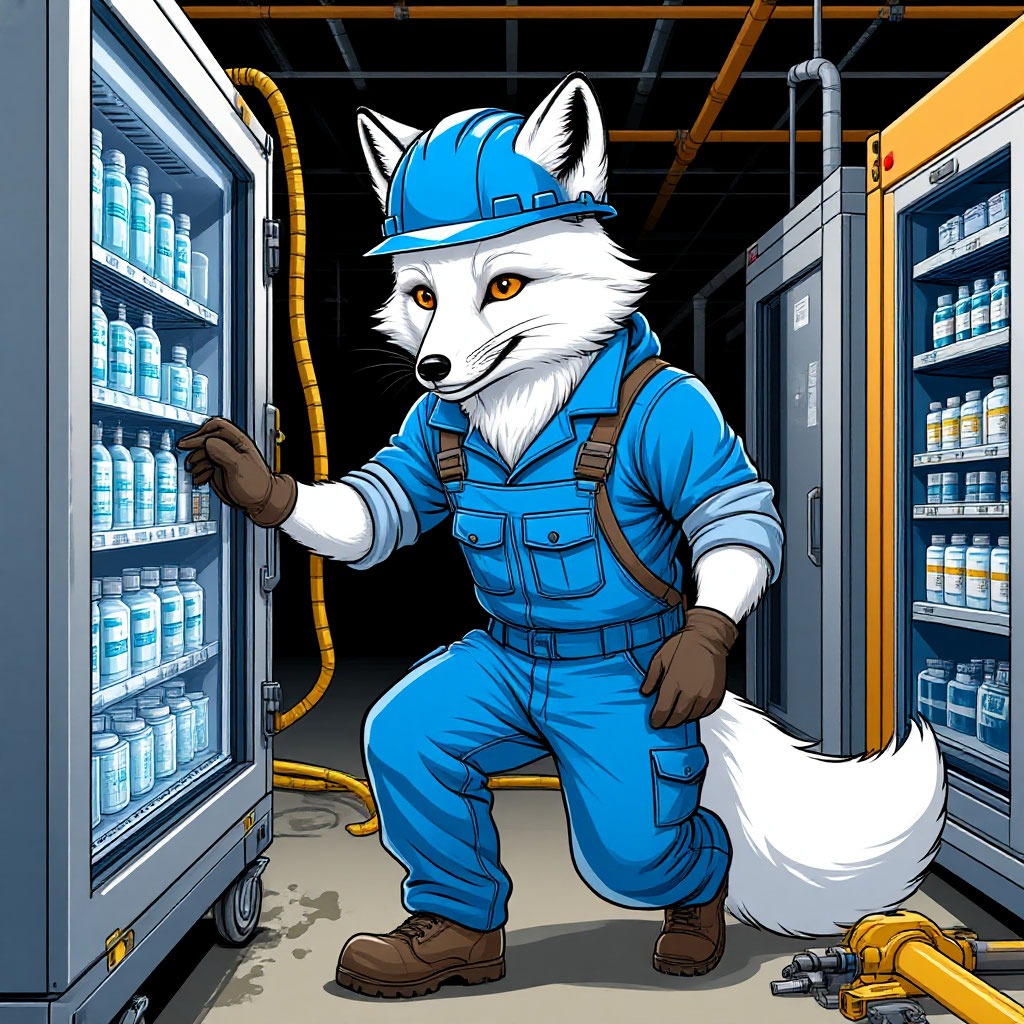
What industrial refrigeration equipment is used in such projects?
A full-cycle biopharmaceutical hub like the one being built in Alatau uses several main types of industrial refrigeration equipment. Each of them performs strictly defined functions. Here are the key positions:
Chillers (chiller units).
Cryogenic refrigeration equipment (cascade refrigeration machines).
Ice generators (ice machines).
Refrigeration chambers and freezing tunnels.
Split systems and precision air conditioners for clean rooms.
Central cooling systems (chiller-fan coil).
Conclusion
The R-Pharma investment project in Alatau is not just another factory, but a comprehensive hub that will require the supply of the most modern and reliable refrigeration equipment. For companies involved in industrial cooling, this is a window of opportunity, from the supply of chillers and cryogenic systems to the creation of turnkey systems with warranty and post-warranty service. The three-year implementation period announced by the government is already prompting market players to prepare commercial proposals and technical solutions to secure their place in this ambitious project. The construction of a hub in Alatau will become a catalyst for the development of the entire industrial refrigeration industry in Central Asia.




In December 2025, Copeland—a global leader in compressor manufacturing—unveiled a new development: a CO₂ scroll compressor featuring Dynamic Vapor Injection (DVI) technology. This milestone marked a significant step in the evolution of industrial refrigeration equipment, as the combination of the natural refrigerant CO₂ and an advanced vapor injection system opens up new possibilities for enhancing energy efficiency, reducing operating costs, and meeting environmental regulations.
 Выберите размер контейнера: Температурный режим: Новый или Б/У: | Прайс-лист на рефрижераторные контейнеры Вы выбрали: 40 футовые, низкотемпературные, новые 
| ||||||||||||||||||||||||||||||||||||||||||||||||||||




 Telegram

