
Icon PreviewIcon PreviewTelegramIcon Preview

In early June 2026, the Key Point Group of Companies officially announced the start of construction of the largest commercial data center in St. Petersburg and the entire North-Western Federal District. With a total capacity of 20 MW and 1,626 IT racks, this facility will be more than just another colocation site; it will be a landmark project that sets new standards for reliability in the region. The first stage of 5 MW and 330 racks (average rack capacity of 8 kW) will be commissioned in Q1 2027 with Tier III certification. The second and third stages, totaling 15 MW and 1,296 racks, will be put on line in Q3 2027 and Q2 2028 — and for the first time in the North-West will receive the maximum Tier IV level of fault tolerance.
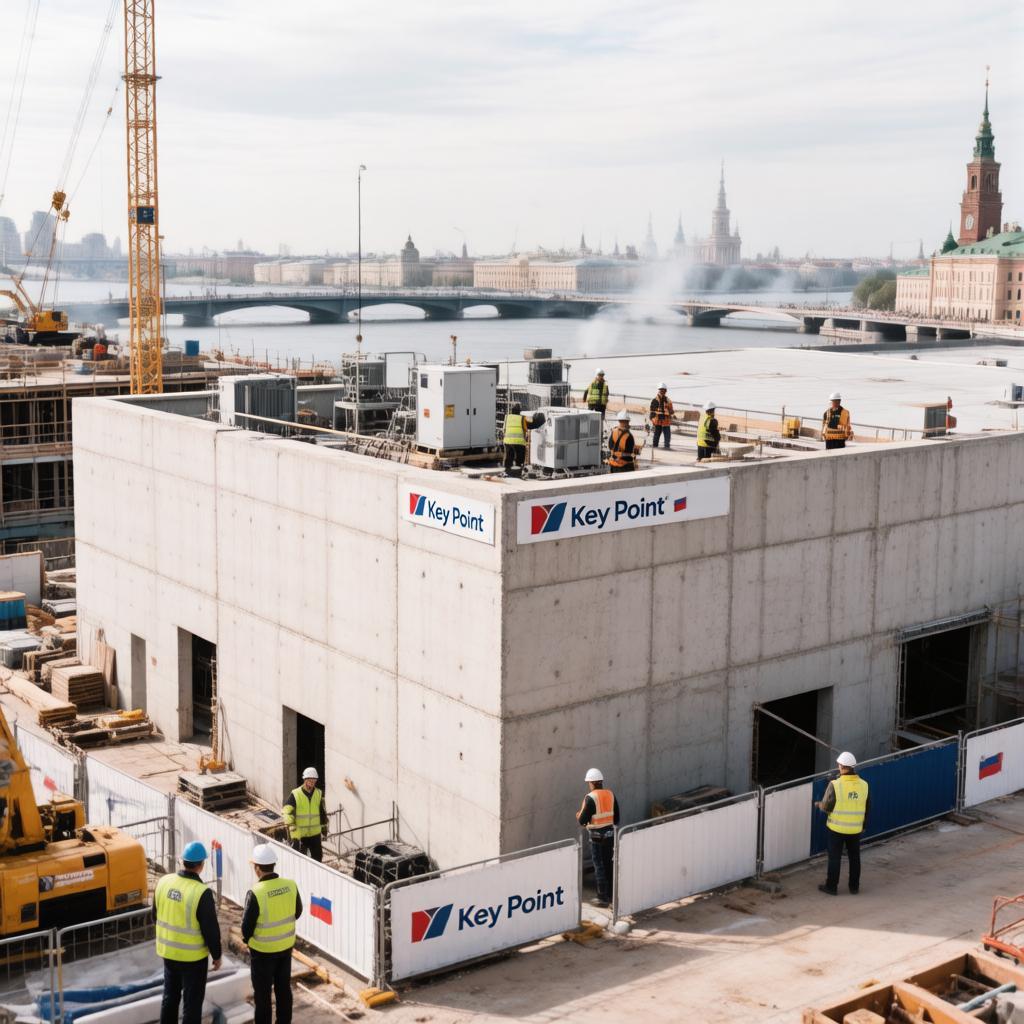
Such an ambitious application will immediately affect related industries, and first of all, companies that produce industrial refrigeration equipment. Data centers are huge consumers of electricity, up to 40% of which is spent on cooling systems. With a capacity of 20 MW and a density of equipment placement of up to 8 kW per rack (and in the future, even higher), classic air conditioning systems are often replaced by more efficient and reliable solutions. For refrigeration equipment contractors and suppliers, this means the opening of a new demand segment with strict requirements for accuracy, continuity, and energy efficiency.

What industrial refrigeration equipment is used in such projects and its key features

Below are the main types of equipment that will be required for the construction and operation of the new Key Point data center, along with their functions and technical specifications.

1. Chillers (central liquid coolers) Chillers are the heart of a large data center's cooling system. They produce cold water or antifreeze, which is then delivered to the fan coils or precision air conditioners inside the server rooms.

  • Function: heat dissipation from servers through an intermediate circuit; maintaining a stable coolant temperature (usually 7-12 °C).
  • Application: In a Key Point data center, air-cooled condenser chillers can be used for the first tier (Tier III), while more reliable models with N+1 or 2N redundancy can be used for subsequent tiers (Tier IV).
  • Specifications: cooling capacity — from 300 to 1500 kW per unit; compressor type — screw or scroll (for operation in a wide range of loads); refrigerant — R134a or R513A (with a low global warming potential); ability to operate at outdoor temperatures up to -30 °C (free cooling mode is required for St. Petersburg with its humid climate).

2. Precision air conditioners (room coolers, CRAC/CRAH) This equipment is installed directly in the server rooms and provides precise climate control.

  • Function: supply of cooled air to the "hot corridors" of the rack, removal of excess heat with an accuracy of ±0.5 °C and ±5% humidity.
  • Application: For 8 kW racks in the Key Point data center, models with high airflow density and the ability to operate with an inlet/outlet temperature difference of up to 12-15 °C are required.
  • Specifications: cooling capacity — 20–100 kW per unit; cooling type — direct evaporative (DX) or water-cooled (CW); fans — EC (electronically commutated) with variable speed for energy savings; support for hot standby.

3. Fan coils and cooling beams (radiator systems) They are used in large halls to distribute cold evenly.

  • Function: heat extraction from the air by passing it through coils with cold water; they can operate in passive (without fans) or active (with small fans) mode.
  • Application: In the Key Point project, active cooling beams are used for rooms with rack density up to 8 kW, as they provide better control with lower energy consumption.
  • Specifications: cooling capacity — 2–15 kW per beam; aerodynamic resistance — low (up to 30 Pa) to reduce the load on the ventilation system; material — copper pipes with aluminum fins; body — made of galvanized steel with a powder coating.

4. Free cooling systems An energy-efficient solution that uses low outdoor temperatures.

  • Function: replacing the chiller compressors during the cold season with direct cooling of the coolant through a dry cooling tower or heat exchanger.
  • Application: In St. Petersburg, where the average annual temperature is around +5°C, free cooling systems can operate up to 60-70% of the year, drastically reducing the operating costs of Key Point's data center.
  • Specifications: the temperature threshold for switching on is below +10 °C; the heat exchangers are plate-type (copper-brazed); the coolant flow rate is 50–200 m³/hour; the pumps are frequency-controlled to adapt to seasonal changes.

5. Dry cooling towers (dry coolers) are required to remove heat from chillers and condensers.

  • Function: Excess heat is discharged into the atmosphere through fans and tubular heat exchangers.
  • Application: In the Key Point data center, several redundant cooling towers are installed for each queue; Tier IV requires full duplication of all elements.
  • Specifications: heat capacity — 200–1200 kW per cooling tower; fans — axial with adjustable blade pitch; housing material — galvanized steel with corrosion protection (aggressive environment of humid air); noise level — no more than 65 dB(A) at a distance of 10 m (requirement for residential areas if the data center is located within the city limits).

6. Heat exchangers and pump stations Transfer heat between cooling circuits.

  • Function: separation of the chiller and internal circuits (to avoid freezing) and refrigerant circulation.
  • Application: The three queues of the Key Point data center will require powerful pump groups with automatic switching and N+1 redundancy.
  • Specifications: pumps with a working pressure of up to 10 bar and a capacity of up to 500 m³/hour; heat exchangers are plate-type and disassembled (for easy maintenance); fittings include stainless steel ball valves and check valves.

7. Inverter compressor units (for VRF/VRV systems) Used for local cooling of administrative and auxiliary data center rooms (offices, low-density server rooms).

  • Function: precise temperature control in individual zones with minimal energy consumption.
  • Specifications: power — 10–50 kW per compressor; refrigerant — R410A; compressor — scroll with inverter drive; maximum length of pipelines — up to 150 m.

For companies involved in industrial refrigeration equipment, the Key Point project is not just the construction of another facility. This is a signal to review the range in the direction of solutions that can work in 24/7/365 mode with a readiness factor of 0.9999 (Tier IV). Especially popular will be chillers and cooling towers with advanced free cooling capabilities, precision air conditioners with high energy efficiency (EER > 4.0) and monitoring systems integrated with the central data center control center. In addition, contractors will need flexibility at the design stage of the first phase: since the second and third phases will be built in parallel, suppliers must be ready to supply large quantities of equipment in a timely manner (6-8 months from order to delivery). The North-West market, which has not yet seen a Tier IV data center, is now receiving a new growth driver, and those who can offer reliable, energy-efficient, and certified solutions will be among the main beneficiaries of this construction.


ADVANTAGES
OF WORKING
WITH US
YOU COOPERATE
WITH ONE
COMPANY
You do not need to spend your time on engagement and negotiations with different contractors and suppliers.
EVERYTHING HAPPENS
IN TIME AND EXACTLY
ACCORDING TO THE PLAN
A long-term operational experience and collaborations guarantee delivery to the customer and installation right on time.
WE SAVE YOUR MONEY
IN A CRISIS WITHOUT
SACRIFICING QUALITY
We have reasonable prices, and we produce some types of equipment by ourselves, offering you the best prices.
Over 10 years of activity, hundreds of Russian companies, from large corporations to small cafes, have become clients of the company.
Copeland launches CO₂ compressor with DVI technology

In December 2025, Copeland—a global leader in compressor manufacturing—unveiled a new development: a CO₂ scroll compressor featuring Dynamic Vapor Injection (DVI) technology. This milestone marked a significant step in the evolution of industrial refrigeration equipment, as the combination of the natural refrigerant CO₂ and an advanced vapor injection system opens up new possibilities for enhancing energy efficiency, reducing operating costs, and meeting environmental regulations.

16
sep 2026






