
Kaltra engineers have modified the design of the microchannel evaporator, allowing it to function effectively as a condenser as well.
Kaltra has launched a new generation of microchannel evaporative heat exchangers. These devices offer reliable performance at extreme temperatures and are fully reversible, making them suitable for use as condensers in heat pumps.
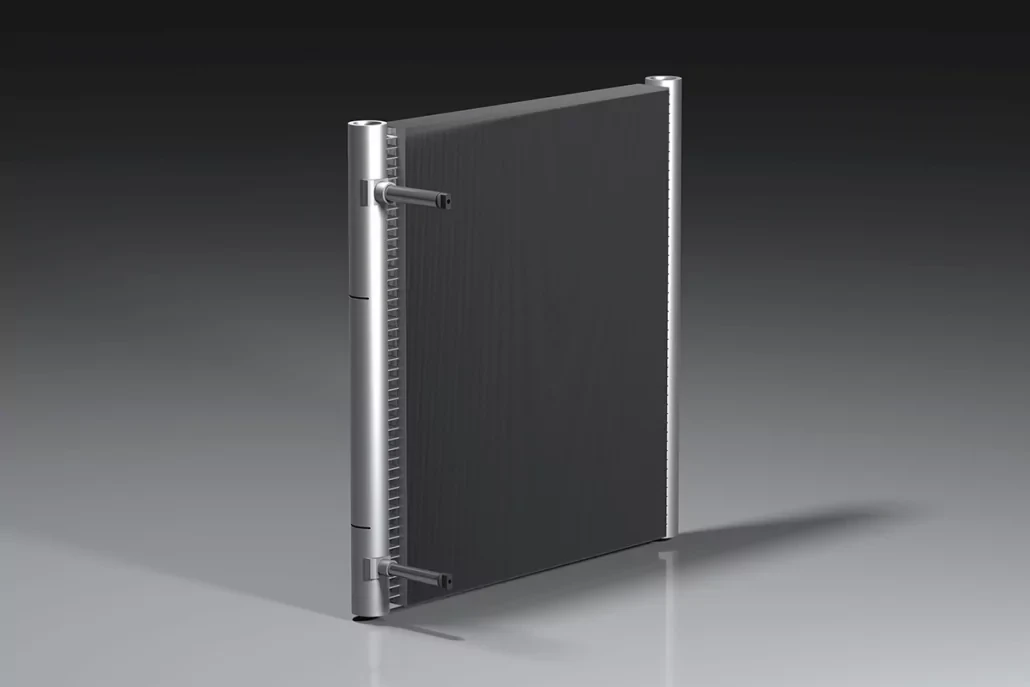
Creating a uniform refrigerant flow and effectively removing condensed moisture are central challenges in the development of such devices. Early models of Kaltra's heat exchangers were successful in addressing these issues individually, but extreme operating conditions such as low load, icing, or use in reverse systems posed significant challenges for the design.
An innovative solution was the horizontal arrangement of microchannel tubes, although this approach was not commonly used in evaporators due to condensation drainage issues.
The company claims that their specialists have managed to eliminate this drawback. They have replaced the standard corrugated fins with vertical louvers equipped with guide edges. The surface temperature of these edges is higher than that of the smooth tube, which slows down the cooling process and directs the resulting condensate downward. This ensures its complete removal and optimizes the formation of frost and subsequent thawing.
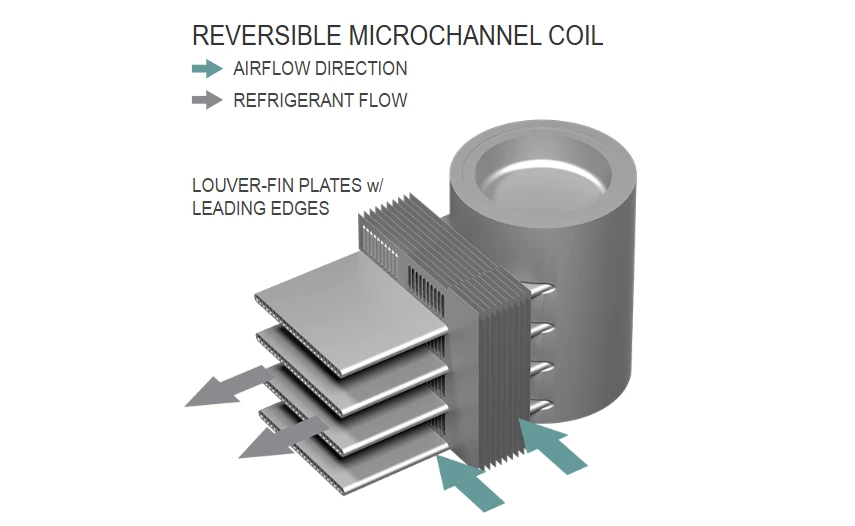
Thanks to the use of vertical louvers, the moisture removal and the behavior of the heat exchanger under icing conditions have almost reached the level of traditional coils with finned tubes, as the geometry of the new finning is close to the classic solutions. At the same time, all the key advantages of microchannel technology have been preserved.
The new horizontal tube layout also allowed for the implementation of a multi-circuit refrigerant circulation system. This increased the overall heat exchange capacity and improved the device's efficiency in reverse mode, where it acts as a condenser.
Another important improvement was the design of the collector. Its internal geometry includes special intermediate plates (throttling partitions) that create turbulent mixing of the liquid and gaseous phases of the refrigerant. This improves the flow distribution across all microchannel tubes, ensures stable thermal parameters, and prevents local overheating.
The heat exchanger's performance has been further enhanced by optimizing the geometry of the circuits, specifically by adjusting the number of tubes in each refrigerant circuit. This has improved the performance in both the evaporation and condensation modes.
According to Kaltra, the efficiency of the new heat exchanger has been tested in laboratory and field trials, including multiple freezing and thawing cycles.
It is reported that a number of heat pump equipment manufacturers have already implemented Kaltra's new developments in their systems. They have noted a significant increase in energy efficiency and stability in both heating and cooling modes.




In December 2025, Copeland—a global leader in compressor manufacturing—unveiled a new development: a CO₂ scroll compressor featuring Dynamic Vapor Injection (DVI) technology. This milestone marked a significant step in the evolution of industrial refrigeration equipment, as the combination of the natural refrigerant CO₂ and an advanced vapor injection system opens up new possibilities for enhancing energy efficiency, reducing operating costs, and meeting environmental regulations.
 Выберите размер контейнера: Температурный режим: Новый или Б/У: | Прайс-лист на рефрижераторные контейнеры Вы выбрали: 40 футовые, низкотемпературные, новые 
| ||||||||||||||||||||||||||||||||||||||||||||||||||||




 Telegram

