
Zhukovsky, located in the Moscow region, has the potential to become a hub for winter sports enthusiasts. Igor Chistyukhin, Deputy Chairman of the Moscow Regional Duma, has announced plans to build a state-of-the-art ice arena, with an impressive investment of 1.1 billion rubles. This project will not only enhance sports and leisure activities in the city, but also have a significant impact on the industrial refrigeration equipment market.
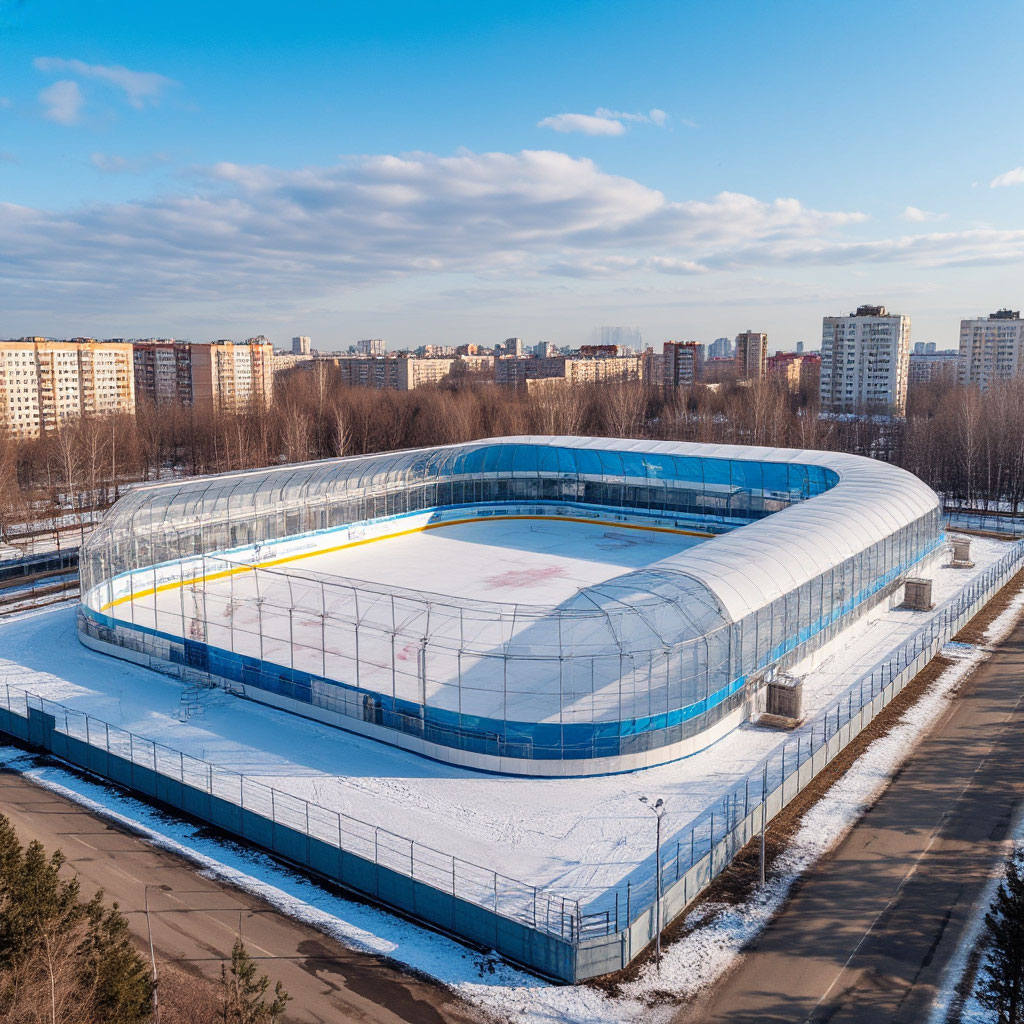
The construction of an ice arena is always a serious challenge for designers and engineers, as it is necessary to create and maintain optimal conditions for training and competitions. A properly selected and reliably functioning industrial refrigeration system plays a key role in this process. This system is responsible for the formation and maintenance of the ice surface, as well as for maintaining a comfortable air temperature inside the arena.
The implementation of the ice arena project in Zhukovsky will inevitably attract the attention of companies specializing in the design, supply, installation, and maintenance of industrial refrigeration equipment. The demand for such services will increase, creating new opportunities for business development and expansion. What systems and equipment might be required for such a project?

1. Refrigeration units (chillers): This is the foundation of any ice arena. Chillers are used to cool the coolant (usually a glycol or propylene glycol solution), which is circulated through a system of pipes located beneath the ice slab. This process is responsible for the formation of ice.
2. Compressor stations: The heart of the refrigeration system. Compressors compress the refrigerant, increasing its temperature and pressure, which is necessary for efficient heat exchange and cold output.
3. Evaporators and condensers: Heat exchange devices that transfer heat between the refrigerant and the coolant (evaporator) and between the refrigerant and the environment (condenser).
4. Ventilation and air conditioning system: This system is necessary to maintain a comfortable temperature and humidity level inside the arena, prevent condensation on the ice surface, and provide high-quality air for spectators and athletes.
5. Monitoring and control system: This is necessary for monitoring and controlling all parameters of the refrigeration equipment, as well as for preventing emergencies.
In conclusion: The construction of the ice arena in Zhukovsky is not just a sports facility, but also a powerful incentive for the development of the industrial refrigeration equipment market. Companies that can offer modern, energy-efficient, and reliable solutions will have an excellent opportunity to expand their business and contribute to the development of sports in the Moscow region. The selection of optimal equipment, competent design, and professional installation are essential for the long-term and smooth operation of the ice arena, as well as for the comfort of athletes and spectators.




In December 2025, Copeland—a global leader in compressor manufacturing—unveiled a new development: a CO₂ scroll compressor featuring Dynamic Vapor Injection (DVI) technology. This milestone marked a significant step in the evolution of industrial refrigeration equipment, as the combination of the natural refrigerant CO₂ and an advanced vapor injection system opens up new possibilities for enhancing energy efficiency, reducing operating costs, and meeting environmental regulations.
 Выберите размер контейнера: Температурный режим: Новый или Б/У: | Прайс-лист на рефрижераторные контейнеры Вы выбрали: 40 футовые, низкотемпературные, новые 
| ||||||||||||||||||||||||||||||||||||||||||||||||||||




 Telegram

