
In the Finnish city of Oulu, one of the world's largest centralized heating and cooling systems using carbon dioxide (CO₂) as a working fluid has been launched. This innovative project, implemented at Nokia's new research and production campus, offers the potential to utilize the waste heat from industrial processes for heating approximately 20,000 households.
A joint development by the local energy company Oulun Energia and the contractor Caverion will supply about 70,000 MWh of thermal energy to the city's heating network every year. This amount covers about 4% of Oulu's annual heat demand. For a city with a harsh climate, where temperatures often drop below freezing, this is a significant step towards improving energy efficiency and reducing environmental impact.
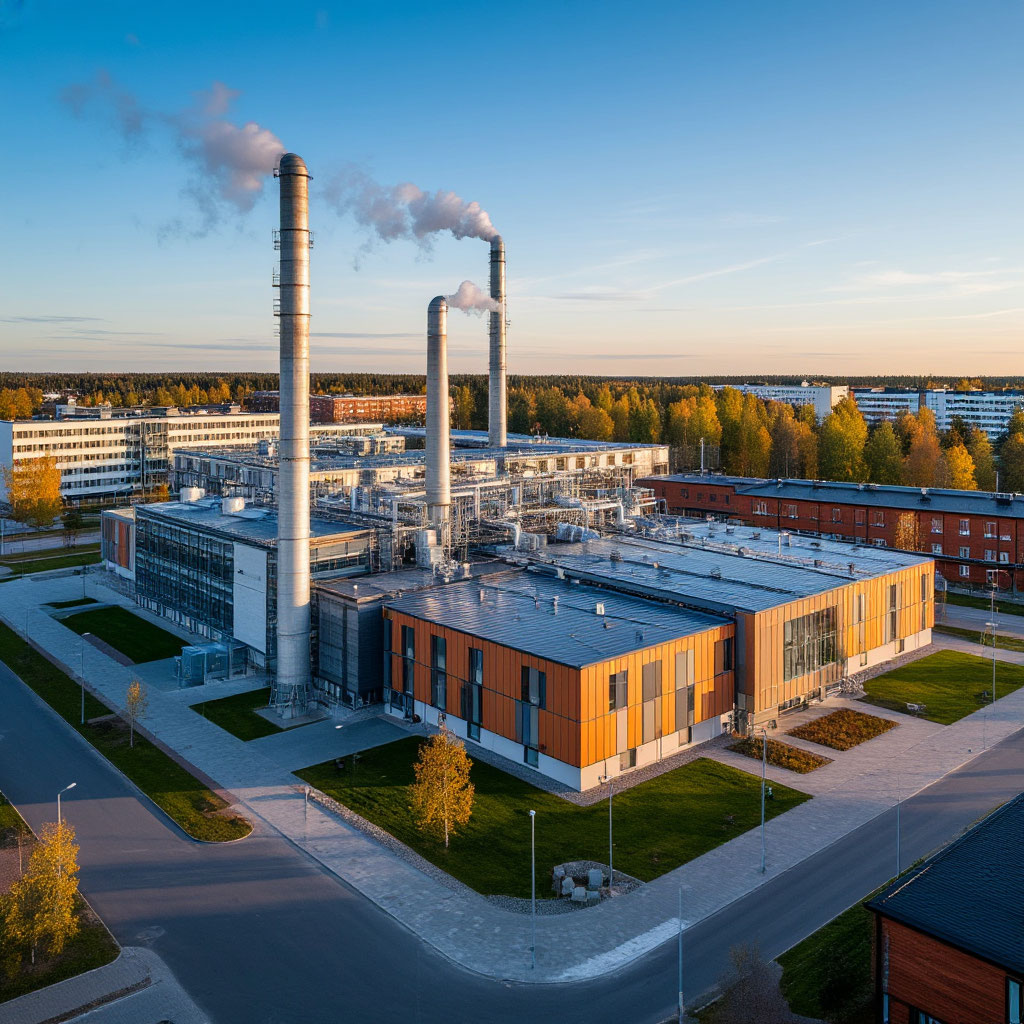
Ville Tamminen, Head of the Finnish business of Caverion, comments: “This power plant is a technology pioneer for modern, carbon-free cooling and heating plants. We are convinced that CO₂ will play a key role as a technology for the high-capacity power plants of the future.”
Sustainability was a key principle in the design of Nokia's new campus. The facility is powered entirely by renewable energy, and all waste heat is fully recycled. This avoids 99% of potential CO₂ emissions.
The project also contributes to Oulun Energia's goal of achieving carbon-neutral production by 2030. As emphasized by Tommy Kantola, the company's Business Director for Energy Services, the use of waste heat in the central heating system is an important step in this direction.
The growing trend of heat recovery is also gaining momentum in other regions of Finland. For example, the Danish company Fenagy has installed six large natural refrigerant heat pumps (R600a isobutane and R290 propane) in North-Eastern Finland to recover heat from a data center. These units, with a total capacity of 30 MW, will increase the heat temperature from the servers from 30°C to 85°C, meeting the needs of the central heating system.
These examples demonstrate a growing trend in the HVACR industry: the use of natural refrigerants such as CO₂, hydrocarbons, and waste heat recovery technologies is becoming the norm for large, environmentally responsible projects around the world.
Impact on companies involved in industrial refrigeration equipment:
The launch of such a large-scale CO₂-based heating and cooling system in Oulu has far-reaching implications for companies specializing in industrial refrigeration equipment.
In conclusion, the launch of the CO₂-based heating and cooling system in Oulu is not just a local project, but a landmark event that will have a significant impact on the development of the entire industrial refrigeration equipment industry, stimulating innovation, promoting the transition to more environmentally friendly technologies, and requiring companies to adapt to new market conditions.




In December 2025, Copeland—a global leader in compressor manufacturing—unveiled a new development: a CO₂ scroll compressor featuring Dynamic Vapor Injection (DVI) technology. This milestone marked a significant step in the evolution of industrial refrigeration equipment, as the combination of the natural refrigerant CO₂ and an advanced vapor injection system opens up new possibilities for enhancing energy efficiency, reducing operating costs, and meeting environmental regulations.
 Выберите размер контейнера: Температурный режим: Новый или Б/У: | Прайс-лист на рефрижераторные контейнеры Вы выбрали: 40 футовые, низкотемпературные, новые 
| ||||||||||||||||||||||||||||||||||||||||||||||||||||




 Telegram

