
The Government of the Russian Federation has included the construction of eight data processing centers (DPCs) in its infrastructure development plan until 2036. This large-scale project will be a significant driver for many industries, including companies specializing in industrial refrigeration equipment. The increased computing power provided by the new DPCs is directly related to the need for efficient heat dissipation from the equipment.
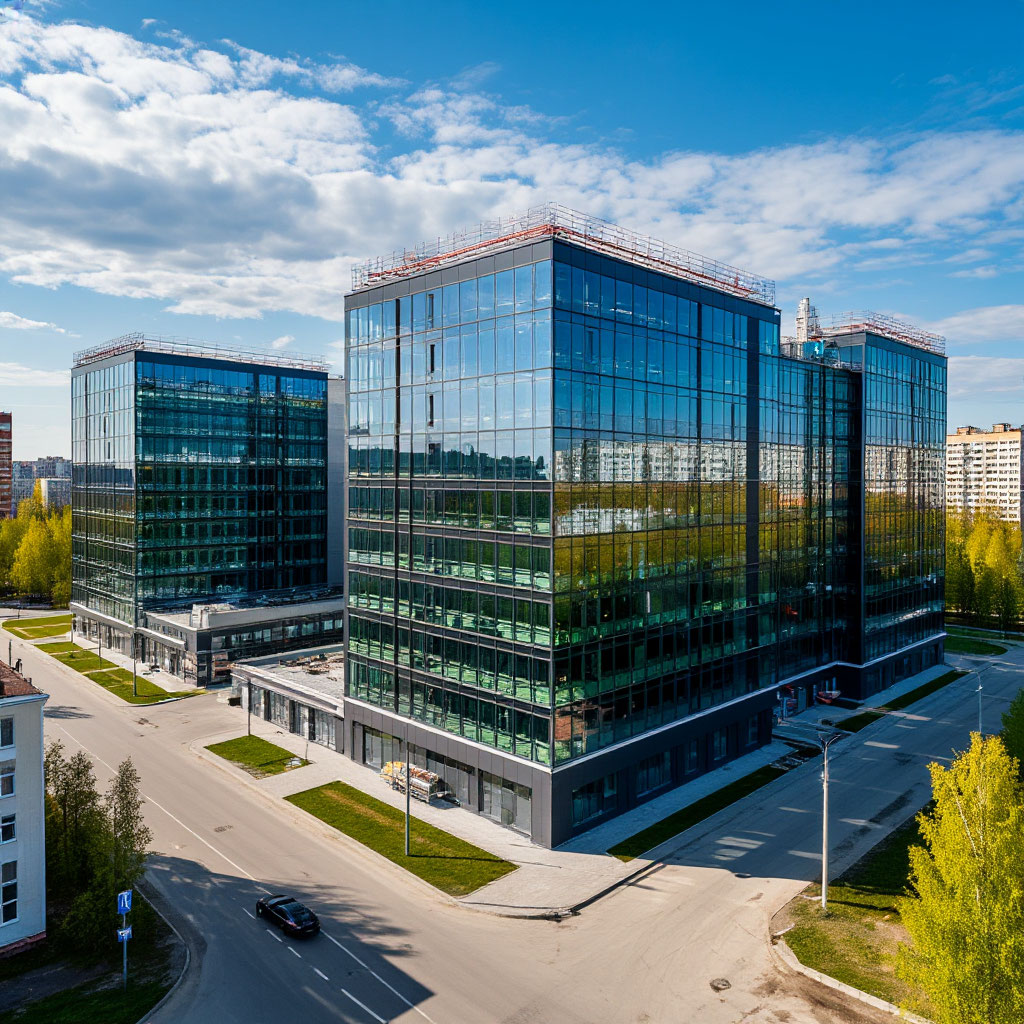
Data Center Construction Schedule and Capacity:
Until 2026: completion of the first and second phases of the Key Point Yekaterinburg data center (880 racks) and the St. Petersburg 2 data center (850 racks). Construction of the latter began in 2024.
2025-2026: construction of the Key Point St. Petersburg data center (1,650 racks) and the Key Point Rostov-on-Don data center (880 racks).
2027: Construction of the Innopolis-2 data center (1,000 racks, completion in 2030) and the Xelent-2 data center (2,100 racks, completion in 2031).
2029: Completion of the Yurlovsky Data Center (1,900 racks), which was started in 2021.
2023-2025: construction of the Udomlya-3 data center (820 racks), which was commissioned by RTC-DC in June of this year.
The impact of data center construction on industrial refrigeration companies
The construction of such a large number of data centers will create increased demand for high-efficiency and reliable cooling systems. Companies that offer advanced solutions in this area will have significant opportunities to grow and expand their businesses. There will also be a growing need for skilled professionals who can design, install, and maintain complex cooling equipment. Additionally, the growth of the data center industry will drive innovation and the development of new, more energy-efficient cooling systems. This, in turn, will lead to lower operating costs and reduced environmental impact.

Industrial Refrigeration Equipment for Data Centers: Types, Functions, and Characteristics
Effective cooling is critical for the reliable and uninterrupted operation of a data center. Overheating of equipment can lead to reduced performance, malfunctions, and even the failure of expensive servers. Various types of industrial refrigeration equipment are used to maintain optimal temperatures in data centers:
Chillers: These units cool water or glycol solution, which is then circulated through a piping system and removes heat from the servers. There are different types of chillers, including air-cooled and water-cooled chillers. Water-cooled chillers are commonly used in data centers because they offer higher efficiency and stable temperature control.
Cabinet-type air conditioners (Close Control Units, CCU): These devices are installed directly in or near server cabinets and provide local cooling for the equipment. CCUs allow for more precise temperature and humidity control in specific areas of the data center, which is particularly important for high-density servers.
Free cooling systems: These systems use outdoor air to cool servers during cold seasons, which can significantly reduce energy consumption. Free cooling can be implemented using various methods, such as air heat exchangers or water cooling systems.
Immersion Cooling Systems: In these systems, servers are immersed in a dielectric fluid that removes heat directly from the components. Immersion Cooling provides very high cooling efficiency and allows you to significantly increase the density of equipment placement.
Cooling towers: Used to remove heat from water-cooled chillers. In cooling towers, water is cooled by contact with air.
Dry coolers (Dry coolants): Used to cool water or glycol solution without direct contact with air, providing a closed loop and minimizing water loss.
The choice of a specific type of refrigeration equipment for a data center depends on a variety of factors, including climate conditions, equipment capacity density, energy efficiency requirements, and budget. However, in any case, a reliable and efficient cooling system is an integral part of a modern data center. The deployment of eight new data centers by 2036 will provide a significant boost to the industrial refrigeration equipment industry, requiring innovative and energy-efficient solutions to maintain the stable and reliable operation of critical infrastructure.




In December 2025, Copeland—a global leader in compressor manufacturing—unveiled a new development: a CO₂ scroll compressor featuring Dynamic Vapor Injection (DVI) technology. This milestone marked a significant step in the evolution of industrial refrigeration equipment, as the combination of the natural refrigerant CO₂ and an advanced vapor injection system opens up new possibilities for enhancing energy efficiency, reducing operating costs, and meeting environmental regulations.
 Выберите размер контейнера: Температурный режим: Новый или Б/У: | Прайс-лист на рефрижераторные контейнеры Вы выбрали: 40 футовые, низкотемпературные, новые 
| ||||||||||||||||||||||||||||||||||||||||||||||||||||




 Telegram

