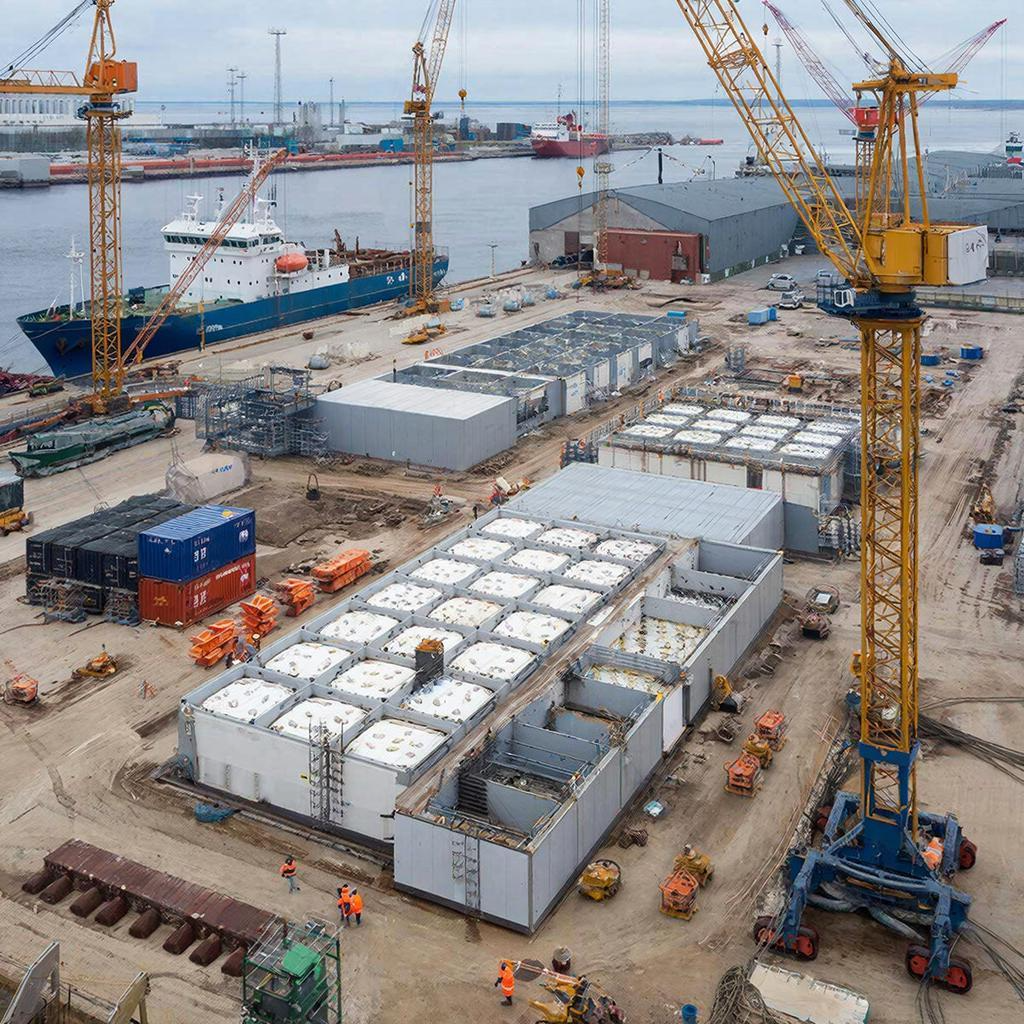
The construction of a large logistics complex for the fish industry in the port of Arkhangelsk, with an investment of 2.5 billion rubles, is a significant impetus for the development of not only the regional transport infrastructure, but also related industrial sectors. One of the key areas that will benefit directly from this project is the production of industrial refrigeration equipment. This project is not just a single order, but rather a long-term market with consistent requirements specific to the fisheries cluster.
Impact on equipment manufacturing companies
For companies specializing in industrial refrigeration equipment, this project opens up several promising directions:
- Growth in production volumes and specialization. The need for refrigerated rooms with a total capacity of 25,000 tons means that large-scale refrigerated warehouses (refrigerators) with support for various temperature regimes must be created. This encourages manufacturers to develop and supply powerful refrigeration systems, including centralized refrigeration stations based on high-capacity compressor units.
- Technological adaptation to the specific product. Fish products (fish and seafood) require strict adherence to temperature ranges, often with separate storage for different types (e.g., fresh fish, frozen fish, and processed products). This increases the requirements for precise temperature, humidity, and air circulation control in the storage chambers. As a result, equipment manufacturers will focus on systems with enhanced automation and monitoring capabilities.
- Development of engineering and service services. A complex is not just a "box" with refrigeration units; it is a complex infrastructure that requires design, equipment integration, commissioning, and further maintenance. This creates a stable market for service divisions of manufacturers or specialized engineering companies.
- A competitive struggle for quality and efficiency. A public/private investment project of this scale involves tender procedures and high requirements for energy efficiency and equipment reliability. This forces manufacturers to compete not only on price, but also on technical specifications, durability, and compliance with environmental standards (such as the use of new-generation refrigerants).
- Creating a reference for further projects. The successful implementation of the project in Arkhangelsk can serve as a model case for similar projects in other Russian fishing ports (for example, in the Far East), providing repeatable and scalable solutions for equipment manufacturers.

Industrial refrigeration equipment used in such complexes, its functions, and characteristics
The logistics complex for fish products will use a wide range of industrial refrigeration equipment, each element performing specific functions:
Large-capacity refrigeration chambers (warehouses). This is the main equipment for storing 25,000 tons of products.
- Functions: Long-term storage of products at a specified temperature (from -25°C for deep freezing to 0…+4°C for refrigerated products).
- Application and characteristics: Multi-chamber structures with thermal insulation (sandwich panels with polyurethane foam). Equipped with powerful refrigeration units (air coolers) connected to an external refrigeration station. The systems have automatic loading doors, stackers, and microclimate control systems.
Central refrigeration stations (chiller units) or compressor-condenser units (CCU).
- Functions: Production and supply of "cold" (chilled liquid or refrigerant) to refrigeration chambers and other consumers.
- Application and characteristics: The stations are located outside the storage facilities. They use powerful compressors (screw or piston), condensers, and receivers. They are characterized by high refrigeration capacity (hundreds of kW), energy efficiency, and the ability to operate on eco-friendly refrigerants (such as R449A and R507). They often have backup units for uninterrupted operation.
Systems for holding live crabs (with a capacity of 200 tons).
- Functions: Maintaining specific conditions to preserve the crab's life: a certain water temperature, water purification, aeration (oxygenation), and possibly step-by-step temperature adaptation.
- Application and characteristics: These are not standard refrigeration chambers, but specialized pools or tanks with a closed water treatment system. Water coolers (liquid chillers), filtration systems, oxygenation systems, and precise temperature controllers are used. The temperature regime is usually close to the natural habitat (for example, +3…+7°C).
Refrigerated containers (400 units) and their connection system.
- Functions: Storage and transportation of products in individual, standardized units (containers) with autonomous or centralized cooling.
- Application and characteristics: The containers themselves are mobile refrigeration chambers. The site requires infrastructure for their technical connection: power supply (for autonomous containers with a diesel or electric generator) and, possibly, central fittings for supplying cooled air from the complex stations. This requires a complex layout of the site with connected utilities.
Automatic monitoring and control systems.
- Functions: Monitoring temperature and humidity in each chamber and container, controlling the operation of units, signaling violations, and collecting data for logistics.
- Application and characteristics: Industrial controllers, sensors (temperature, humidity, pressure), and SCADA software are used. They provide round-the-clock control, which is critical for maintaining the quality of fish products.
Thus, the construction of a logistics complex in Arkhangelsk forms a comprehensive order for high-tech industrial refrigeration equipment, stimulating domestic manufacturers to develop technologies, increase production capacities, and improve service support. This contributes to strengthening the entire value chain in the fisheries sector, from fishing to the end consumer.











 Telegram

