
In Nizhny Novgorod, there is serious talk about the construction of a new indoor ice arena that will be adapted for bandy. This sport, which has a long tradition in the region, has long been in need of modern infrastructure. The arena is planned to serve as the home ground for the Start team, which currently has to train and play matches in conditions that are far from ideal. The idea was discussed in the regional Legislative Assembly: Vasily Sukhanov, Chairman of the Committee on Urban Development, met with Sergey Myaus, Director for Cooperation with Executive Authorities of the Russian Federation and International Sports Organizations of the Russian Bandy Federation. The lack of a modern facility for year-round training and competitions has long been a concern for Nizhny Novgorod athletes, and with the support of the federation and the regional government, this issue may be resolved.
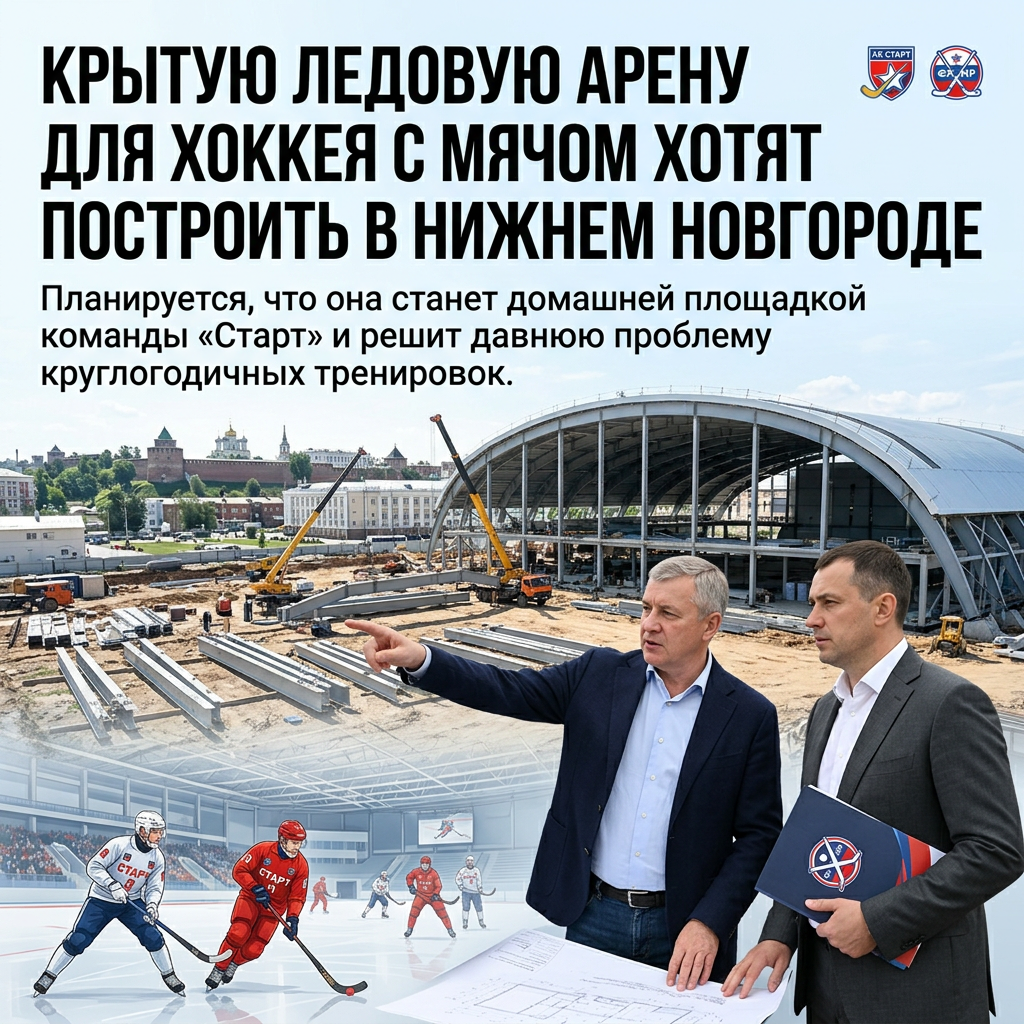
The news of the arena construction itself is a significant step for sports. However, behind the scenes of this project, an equally important engineering and commercial story unfolds, which directly affects companies engaged in industrial refrigeration equipment. For any ice arena, the refrigeration system is the heart, the circulatory system and the skeleton at the same time. Without it, it is impossible to create and maintain high-quality ice, especially in conditions of year-round operation. The project in Nizhny Novgorod, which is specifically focused on bandy, has its own specific features: the field is significantly larger than in classical ice hockey, and the requirements for ice uniformity and thickness are higher. This means that the volume of orders for manufacturers and suppliers of refrigeration equipment will be significant, and the technical solutions will be more complex.
For companies operating in the industrial refrigeration segment, the launch of such a project is not just a single sale of compressors or evaporators. It is a comprehensive contract that includes design, supply, installation, commissioning, and subsequent service. With Russia actively developing its sports infrastructure, each new arena becomes a testing ground for implementing modern technologies and expanding the portfolio of orders. Companies that can offer energy-efficient solutions stand out, as ice maintenance is one of the most expensive expenses for any ice rink.
What specific industrial refrigeration equipment is used in such projects? Let's explore the key components, their functions, and technical specifications.
1. Compressor-condenser units (chiller) This is the main source of cold. Screw or piston compressors are most commonly used for ice arenas. Screw compressors (such as those based on R-507 or R-404A refrigerants) are preferred for large loads because they provide high performance (200 to 2000 kW or more) and stable operation during significant temperature fluctuations. Their purpose is to cool the coolant (usually an ethylene glycol or propylene glycol solution), which is then circulated under the ice slab. Specifications: The refrigeration capacity of modern models reaches 3.5-4.5, which reduces energy consumption. Chiller units are equipped with soft starter systems and frequency converters for power regulation.
2. Complete evaporative stations (fan coils and air coolers) They are mounted inside the refrigeration chamber (the sub-arena room where the equipment is located) and directly under the ice field. The key element is the evaporators for freezing the concrete slab. These are typically panel or tube-fin evaporators made of galvanized steel or aluminum. They provide heat exchange between the refrigerant and the heat transfer fluid. For a bandy arena, the ice field area should be about 6,000-7,000 square meters. Accordingly, the capacity of the evaporators should be such that the slab can be frozen up to 10 cm thick in 24-48 hours. Their function is to remove the heat that is generated during the freezing and maintenance of ice. Characteristics: the refrigerant outlet temperature usually varies from -10 to -15 °C, the heat exchange area can reach 3-5 thousand square meters.
3. Pumping stations and circulation systems After the coolant has been cooled in the chiller, it must be evenly distributed under the entire surface of the field. This is achieved using high-capacity circulation pumps (e.g., 50 to 200 cubic meters per hour) with frequency control. The system consists of large-diameter pipelines (100 to 200 mm), typically made of high-density, corrosion-resistant polyethylene. These pumps are responsible for pumping the solution through hundreds of kilometers of pipes embedded in the concrete slab. Without precise flow balancing, zones with different ice thicknesses may occur, which is unacceptable for ball hockey, which requires a perfectly flat surface.
4. Control and automation system (SCADA) This is the "brain" of the entire refrigeration system. In industrial projects, multi-level controllers are implemented to manage all processes, from starting the compressors to adjusting the temperature based on the external weather conditions. For example, in the Nizhny Novgorod region, where winters are cold but summers are hot, the system must automatically switch between different modes. Temperature, pressure, and humidity sensors are installed in each node. Modern SCADA systems allow for remote monitoring of the arena's operations, reducing operational costs by 20-30%.
5. Dehumidification and ventilation systems Bandy is a dynamic sport with high humidity from players' breathing and melting ice. To prevent fog and condensation, industrial air dehumidifiers (sorption or condensation) are installed. They maintain humidity at 40-50%. The capacity of dehumidifiers for a large arena can be 500-1000 liters per day. In parallel with them, supply units with heat recovery work to minimize heat loss.

As for the impact on companies involved in industrial refrigeration equipment, the construction of the arena in Nizhny Novgorod will be a powerful incentive for them. Firstly, it is a long-term contract for the supply of equipment, from compressors to automation. Secondly, once the arena is put into operation, there will be a stage of service and modernization, which will provide the company with work for the next 10-15 years. Additionally, such projects enhance the company's reputation in the eyes of federal customers. If a company successfully implements a complex project for bandy, it opens the door to other sports facilities, such as ice rinks and stadiums.
Finally, the demand for energy efficiency is forcing manufacturers to develop new, more compact, and less noisy units. In urban environments, arenas are often located in residential areas, making noise and vibration requirements stringent. Companies that can offer quiet yet powerful systems will have a competitive advantage.
Thus, the construction of an indoor ice arena in Nizhny Novgorod is not only a victory for sports, but also a significant opportunity for the industrial refrigeration sector. Investing in modern infrastructure will lead to orders for thousands of pieces of equipment, the creation of new jobs, and the development of technologies that will be applied in other regions.




In December 2025, Copeland—a global leader in compressor manufacturing—unveiled a new development: a CO₂ scroll compressor featuring Dynamic Vapor Injection (DVI) technology. This milestone marked a significant step in the evolution of industrial refrigeration equipment, as the combination of the natural refrigerant CO₂ and an advanced vapor injection system opens up new possibilities for enhancing energy efficiency, reducing operating costs, and meeting environmental regulations.
 Выберите размер контейнера: Температурный режим: Новый или Б/У: | Прайс-лист на рефрижераторные контейнеры Вы выбрали: 40 футовые, низкотемпературные, новые 
| ||||||||||||||||||||||||||||||||||||||||||||||||||||




 Telegram

