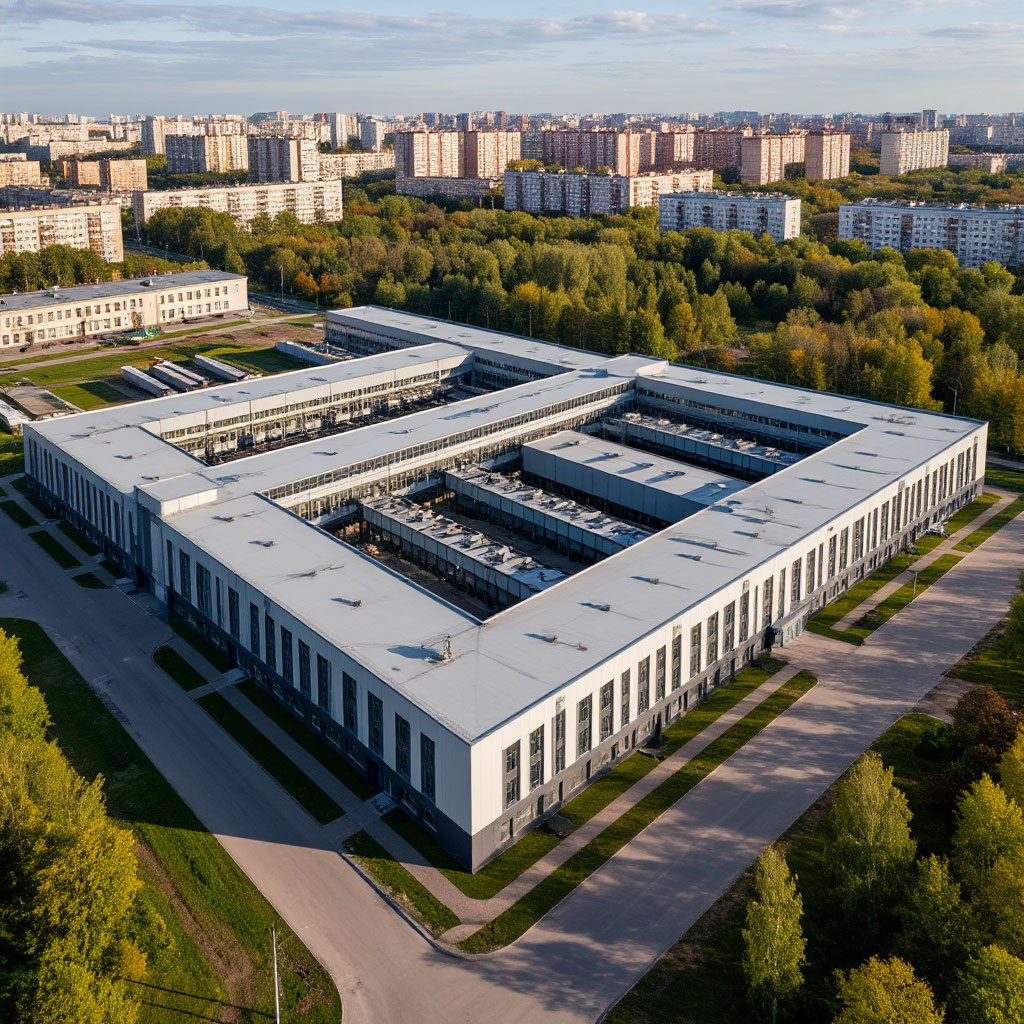
In St. Petersburg, an ambitious project has been launched: the construction of a multi-temperature warehouse complex with a total cost of 2.5 billion rubles. Located on a 6.4-hectare plot on Sofiyskaya Street, this facility promises to become a key link in the city's logistics chain. The three buildings, with a total area of 34,000 square meters, will meet the most modern requirements for storing products that require different temperature conditions. The key advantage of the location is its proximity to the Nart agro-park and convenient access to the lightly trafficked Sofiyskaya Street, which provides optimal transport accessibility for key customers.
The news of the construction of such a large-scale complex could not go unnoticed by companies involved in industrial refrigeration equipment. The commissioning of a facility of this scale creates significant demand for a wide range of refrigeration equipment, opening up new opportunities for manufacturers, suppliers, and service companies. In fact, the emergence of a multi-temperature complex stimulates the growth and development of the entire sector, pushing companies to innovate and improve the quality of their solutions.
The impact of construction on companies that produce industrial refrigeration equipment:
The construction of a multi-temperature complex will have a multifaceted positive impact:
- Increased demand: The main benefit is a sharp increase in demand for refrigeration equipment for various temperature regimes. This includes refrigeration chambers, freezing chambers, shock freezing, and temperature monitoring and control systems.
- Increased competition: To meet the increased demand, both new players and existing companies will enter the market, expanding their product offerings and offering more competitive prices and conditions.
- Encouraging Innovation: In a highly competitive environment, companies will be forced to invest in the development and implementation of new technologies aimed at improving the energy efficiency, reliability, and ease of maintenance of their equipment.
- Development of service infrastructure: The commissioning of a large complex will require the availability of qualified specialists in the installation, maintenance, and repair of refrigeration equipment. This will lead to the development of service infrastructure and the creation of new jobs.
- Increased quality requirements: Modern warehouse complexes have high requirements for the reliability and safety of equipment. This will force supplier companies to pay more attention to product quality and compliance with international standards.

Industrial refrigeration equipment used in multi-temperature complexes:
A multi-temperature warehouse complex involves the use of a wide range of refrigeration equipment that allows for the storage of products at various temperatures. Key components include:
- Medium-temperature refrigerators (from +2°C to +8°C): Designed for storing refrigerated products such as fruits, vegetables, dairy products, meat, and fish.
- Specifications: Medium-capacity compressors, automatic defrosting systems, efficient thermal insulation, and real-time temperature monitoring systems.
- Application: Storage of food products that require a temperature range of +2 to +8 degrees Celsius.
- Low-temperature freezers (-18°C to -25°C): Used for storing frozen foods such as meat, fish, vegetables, and fruits.
- Specifications: Powerful compressors, automatic defrosting systems using hot gas or electricity, special thermal insulation panels with high frost resistance, and temperature alarm systems.
- Application: Long-term storage of frozen food products.
- Shock freezing chambers (from -30°C to -40°C): Designed for rapid freezing of products, which helps to preserve their quality and nutritional value.
- Specifications: High-performance compressors, intensive cold air blowing over the products, short freezing cycle (no more than a few hours), and automated freezing process control systems.
- Application: Freezing berries, fruits, vegetables, meat, fish, and semi-finished products to preserve their freshness and taste.
- Refrigeration units and central units: Provide refrigeration for refrigeration chambers and other refrigeration equipment.
- Specifications: Refrigeration capacity from several kilowatts to several megawatts, use of various types of compressors (piston, scroll, screw), heat recovery systems, and automated control and monitoring systems.
- Application: Centralized refrigeration for the entire warehouse complex.
- Temperature control and monitoring systems: Provide constant temperature monitoring in refrigerated rooms and allow for prompt response to any deviations.
- Features: Temperature sensors, controllers, alarm systems, data archiving systems, and remote monitoring and control capabilities.
- Application: Maintaining a stable temperature regime and preventing product spoilage.
- Air coolers and condensers: They provide heat exchange between the refrigerant and the air in refrigeration chambers.
- Specifications: Various types of fins, high-efficiency fans, defrosting systems, and corrosion-resistant materials.
- Application: Efficient air cooling in refrigeration chambers and heat dissipation from condensers.
- Thermal insulation panels: Provide tightness and thermal insulation for refrigeration chambers.
- Specifications: High degree of thermal insulation, various thickness and density, fire resistance, and hygienic.
- Application: Minimizing heat loss and maintaining a stable temperature inside refrigerated chambers.
- Refrigeration doors: Provide access to refrigeration chambers and minimize heat loss when opened.
- Specifications: Various types (swing, roll-up, sectional), seals, doorway heating systems, and automatic opening and closing capabilities.
- Application: Easy access to refrigerated rooms and minimization of heat loss.
In conclusion, the construction of a multi-temperature warehouse complex in St. Petersburg will be a powerful catalyst for the development of the industrial refrigeration equipment market, opening up new opportunities for companies operating in this field and contributing to the improvement of food quality and safety.











 Telegram

