
On January 20, 2026, at the V meeting of the National Kurultai, President Kassym-Jomart Tokayev announced an ambitious plan that could reformat not only the digital landscape of the country, but also entire industries. We are talking about creating a Valley of data processing centers (DPCs) in Pavlodar region, based on the Ekibastuz energy basin. The project involves the construction of a powerful cluster of data centers powered by electricity generated from Ekibastuz coal. The government, together with the regional akimat, is already reserving a 200 — hectare plot of land for these purposes, as well as preparing infrastructure-from water supply and access roads to telecommunications networks and power lines. It is expected that this project will become the foundation for the formation of an international hub for cloud services and artificial intelligence in Central Asia.
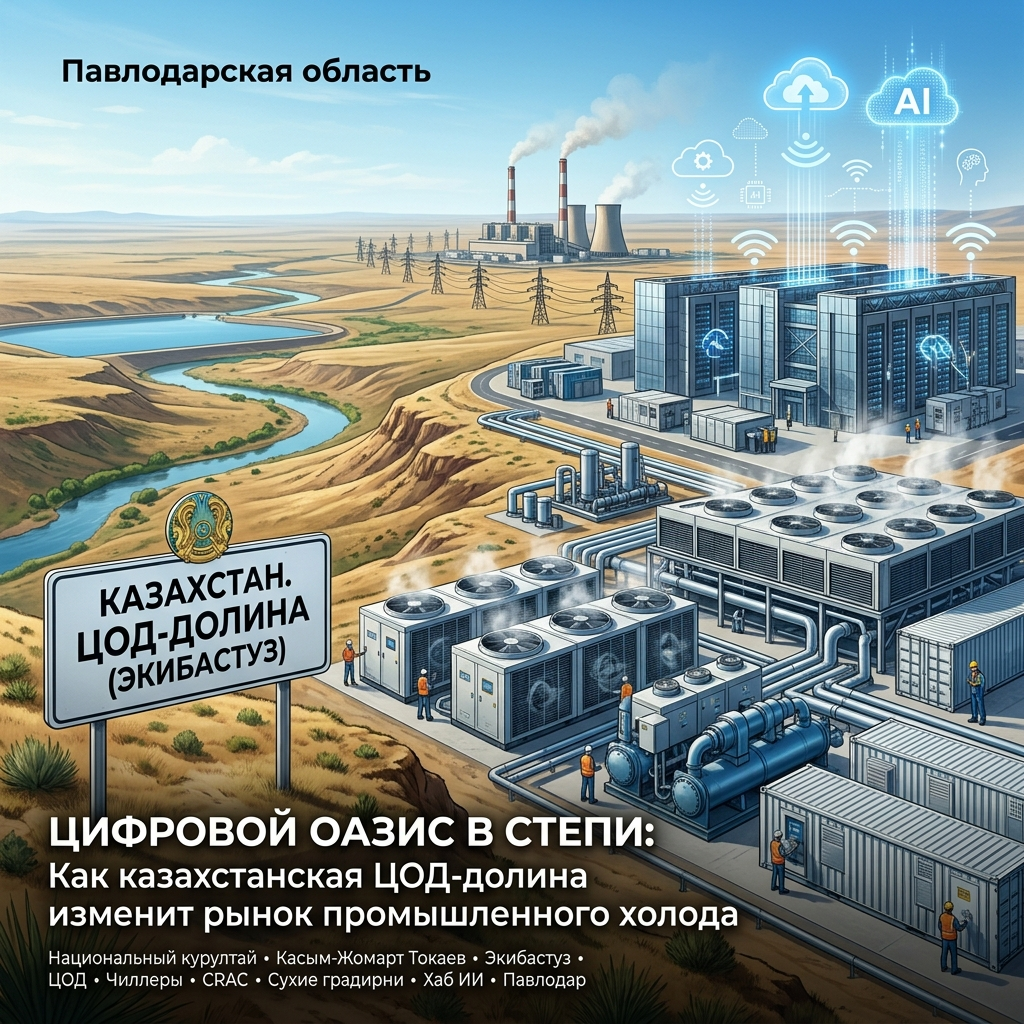
However, the external appeal of the "digital valley" hides an equally important engineering aspect, which often remains in the shadows. Any modern data center is primarily a complex heat management system. Server racks, especially those designed for training and inference AI models, generate a huge amount of heat. In the sharply continental climate of Pavlodar region, where summer temperatures can exceed 40 degrees Celsius, and in winter the thermometer drops below minus 40, the problem of heat removal becomes critical. It is here that companies specializing in industrial refrigeration equipment come to the forefront, and this project opens up unprecedented prospects for them.
The impact of the initiative on this sector will be multi‑level. First, it will lead to a direct increase in demand for high‑tech cooling systems. Previously, the Kazakhstani market focused mainly on standard fan and split systems for small server rooms, but now industrial solutions capable of handling hundreds of megawatts of thermal load will be required. Second, the geography of supplies and logistics will change. Ekibastuz is located far from major industrial centres, which will require refrigeration equipment manufacturers to set up local service centres, stockpiles and mobile repair teams. Thirdly, energy efficiency requirements will increase. Given that electricity will be generated from coal, any extra kilowatt spent on cooling reduces the profitability of the entire cluster. This encourages the adoption of technologies with heat recovery and the use of natural cold air during the winter period (free cooling).
Now let’s look at the specific types of industrial refrigeration equipment that will be needed for such a project, as well as their functions and characteristics.
1. Precision air conditioners (CRAC and CRAH).
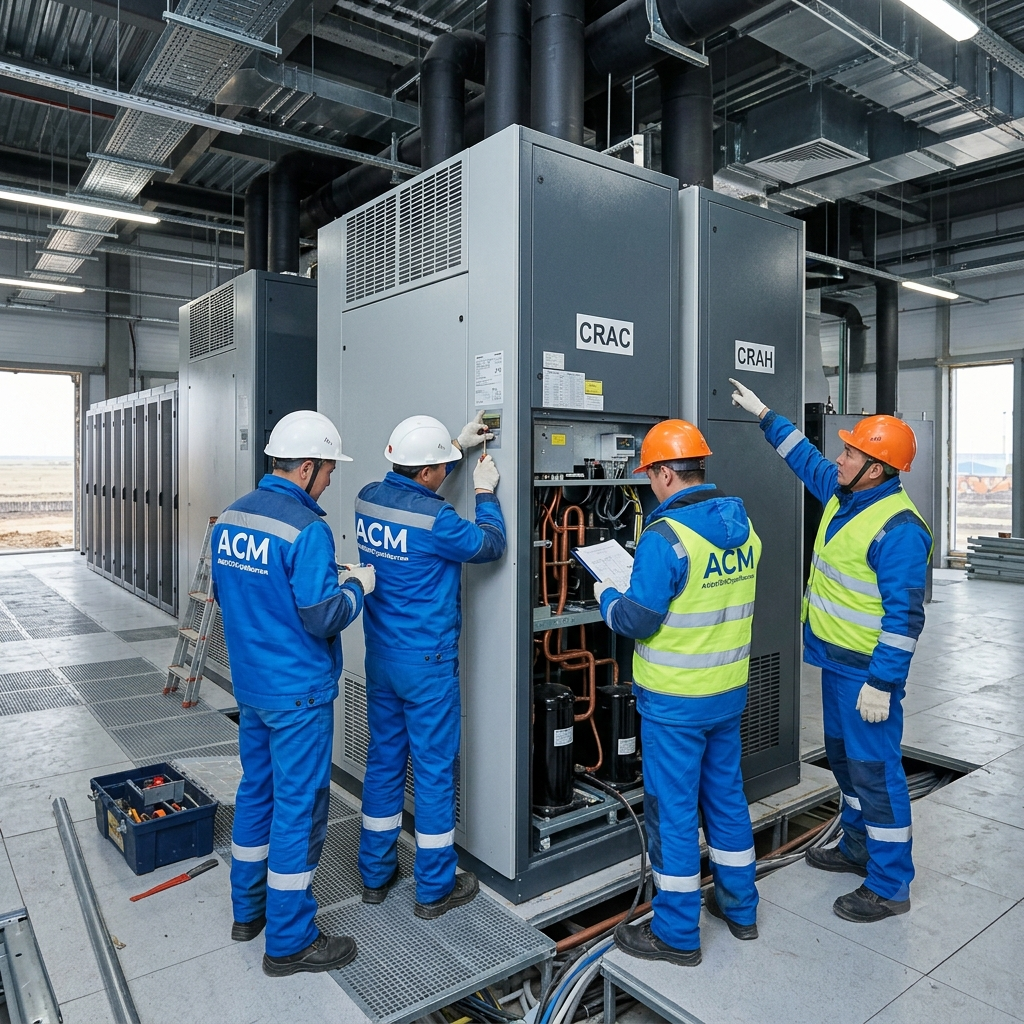
This is the foundation of any data center. CRAC (Computer Room Air Conditioner) are monoblock systems that cool the air directly in the room. They ensure precise maintenance of temperature and humidity within the range of 18-27°C and 40-60% relative humidity. Characteristics: capacity from 20 to 200 kW, use of highly efficient compressors with inverter control, regulation accuracy of ±0.5°C. In the Ekibastuz Valley, they will be used in small “cold corridors” and for local, targeted cooling of particularly hot racks. CRAH (Computer Room Air Handler) are more powerful systems that operate using chilled water. They remove heat from the room via fan coils and transfer it to the chiller circuit. Their advantage is scalability and the ability to use natural cooling when the outdoor air temperature is below 10°C.
2. Chillers (water coolers).
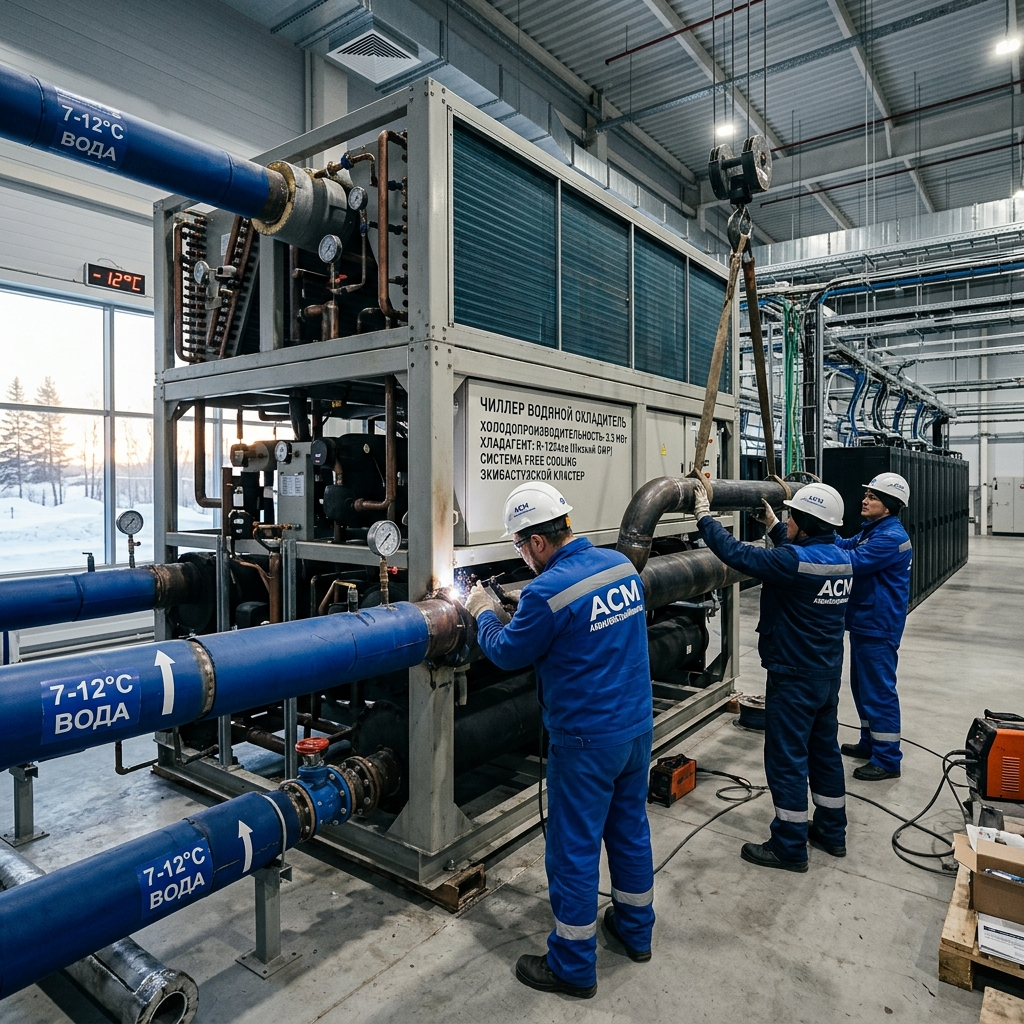 This is the heart of the central cooling system. In industrial applications, they are used to prepare chilled water (usually 7-12°C), which circulates in a closed loop to the fan coils. The Ekibastuz cluster will require high‑performance chillers with screw or centrifugal compressors. Characteristics: cooling capacity from 500 kW to 10 MW or more, the use of freon refrigerants with low global warming potential (for example, R-1234ze), the presence of a free cooling system (free cooling), which in winter allows you to turn off the compressors and use external cold through heat exchangers. This is crucial for reducing energy consumption, as the air temperature in Pavlodar is below 5°C for more than 150 days a year.
3. Modular freon cooling systems.
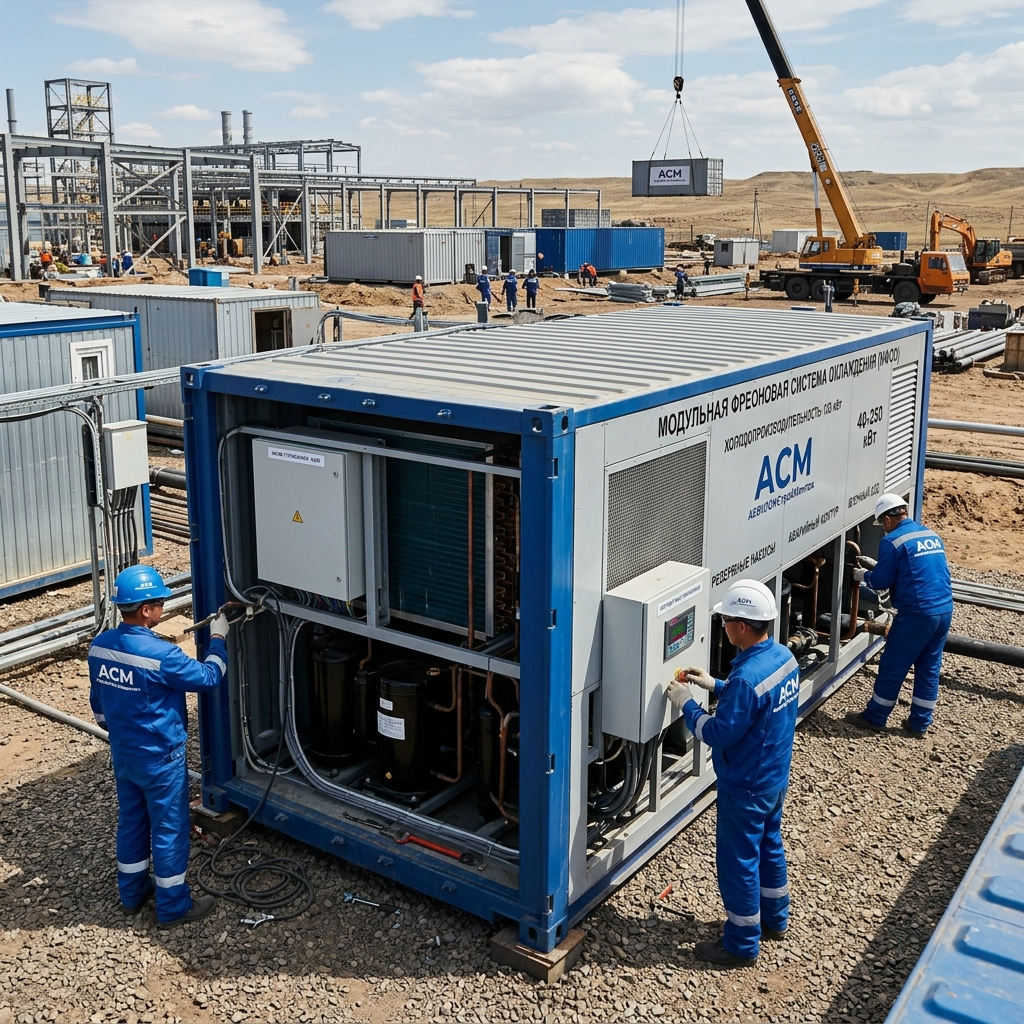
These are compact solutions, often referred to as" container "or" block " data centers. They are sealed modules that include compressor units, evaporators, condensers, and automatic control systems. Their main function is rapid commissioning and independent cooling of individual sections of the valley. Characteristics: modular architecture from 40 to 250 kW per unit, the ability to be combined in cascades, low noise level, high maintainability, the presence of backup pumps and automatic switching to the emergency circuit. In Ekibastuz, they can be used as temporary solutions during the construction phase, as well as to ensure uninterrupted operation of critical segments of the AI cluster.
4. Dry cooling towers and drycoolers. These are systems for removing heat from the chiller circuit to the atmosphere. Unlike classic evaporative cooling towers, they do not use water for cooling, but only blow air through heat exchange sections. This significantly saves water resources, which is extremely important for the steppe region. Characteristics: heat output from 200 kW to several megawatts, the use of low-noise fans with frequency control, the ability to work in extremely low temperatures (up to -45°C) without the risk of defrosting. Their function is to provide year-round heat removal from the chillers ' condensers, creating a closed cycle with minimal water consumption.
5. Thermosiphon systems and systems with a phase transition. In recent years, high-density servers have been increasingly equipped with boiling liquid cooling technologies (two-phase immersion cooling). This is when server boards are completely or partially submerged in a dielectric liquid that boils at a temperature of 60°C and removes heat due to the phase transition. Characteristics: the heat sink coefficient is 10-20 times higher than that of air cooling, the complete absence of fans in the rack, which reduces energy consumption by 30-40%, high equipment placement density. For AI clusters, where each server allocates 3-5 kW, this is an ideal solution. However, such systems require specialized refrigeration equipment to condense the vapors and return the liquid to the circuit. Compact water-or air-cooled condensers paired with external drycoolers will be in demand here.
6. Industrial refrigeration compressors and heat exchangers. Despite their apparent simplicity, each chiller and each CRAH system consists of dozens of complex components. Within the scope of the data center valley project, there will be a high demand for variable speed screw compressors (VSD), plate and shell-and-tube heat exchangers, as well as air dehumidification systems. The function of the latter is not only cooling but also preventing moisture condensation on the electronics, which is critical during sudden temperature changes. Characteristics: airtightness, corrosion resistance (important, since Ekibastuz has a high content of coal dust), the ability to operate in an aggressive environment.
A key feature of the project implementation will be the need to combine all these systems into a single hierarchical complex. The external unit consists of cooling towers and dry coolers located away from buildings to avoid raising the temperature in the work area. The internal circuit consists of chillers with pump stations. The intermediate level consists of fan coils and precision air conditioners. And finally, the lowest level consists of micro‑coolers built directly into the racks. All of this must be managed by a single automation system that monitors temperature, pressure, and humidity in real time at each site.
For companies operating in the field of industrial refrigeration, this means not only an increase in supply volumes, but also the need for a serious technical transformation. Reliability requirements come to the fore here. In the valley of the data center, where government data and cloud services will be hosted, even a five-minute downtime can lead to financial losses in the tens of millions of tenge. Therefore, the equipment must have N+1 or 2N redundancy, as well as the ability to perform scheduled maintenance work without stopping the entire cluster. Manufacturers offering ready‑made modular solutions with redundant circuits and intelligent dispatching will gain a significant competitive advantage.
Furthermore, the project will stimulate the development of the local engineering base. There will be a need for specialists in the maintenance of refrigeration systems who are capable of working with high‑voltage equipment and programmable logic controllers. Local enterprises can start assembling individual components — from frame structures to pumping stations — which will reduce dependence on imports and create new jobs.
Thus, the creation of a data center valley in Ekibastuz is not only a digital, but also an industrial challenge. For the industrial refrigeration equipment industry, this is a signal that Kazakhstan is entering a new era — the era of high-density computing, where every unit of heat generated must be efficiently disposed of. Companies that are already investing in the development of energy-efficient systems using natural cold and two-phase technologies will be able to take a leading position in this market. Large-scale work on infrastructure creation is ahead, and those who are ready to offer integrated solutions, rather than individual components, will become key partners in the implementation of the strategic initiative of the head of state. Ultimately, this will allow Kazakhstan not only to take its rightful place in the global data center map, but also to create a closed cycle — from coal to artificial intelligence, where cold is no less important resource than electricity.




In December 2025, Copeland—a global leader in compressor manufacturing—unveiled a new development: a CO₂ scroll compressor featuring Dynamic Vapor Injection (DVI) technology. This milestone marked a significant step in the evolution of industrial refrigeration equipment, as the combination of the natural refrigerant CO₂ and an advanced vapor injection system opens up new possibilities for enhancing energy efficiency, reducing operating costs, and meeting environmental regulations.
 Выберите размер контейнера: Температурный режим: Новый или Б/У: | Прайс-лист на рефрижераторные контейнеры Вы выбрали: 40 футовые, низкотемпературные, новые 
| ||||||||||||||||||||||||||||||||||||||||||||||||||||




 Telegram

