Major market players are calling for stricter global energy efficiency standards for air conditioning systems. Leading international companies—including Danfoss, Johnson Controls, and ABB—have issued a joint appeal to global policymakers under the banner of the "Smart Energy Coalition." Their primary demand is an urgent tightening of Minimum Energy Performance Standards (MEPS) for both residential and commercial air conditioning systems.
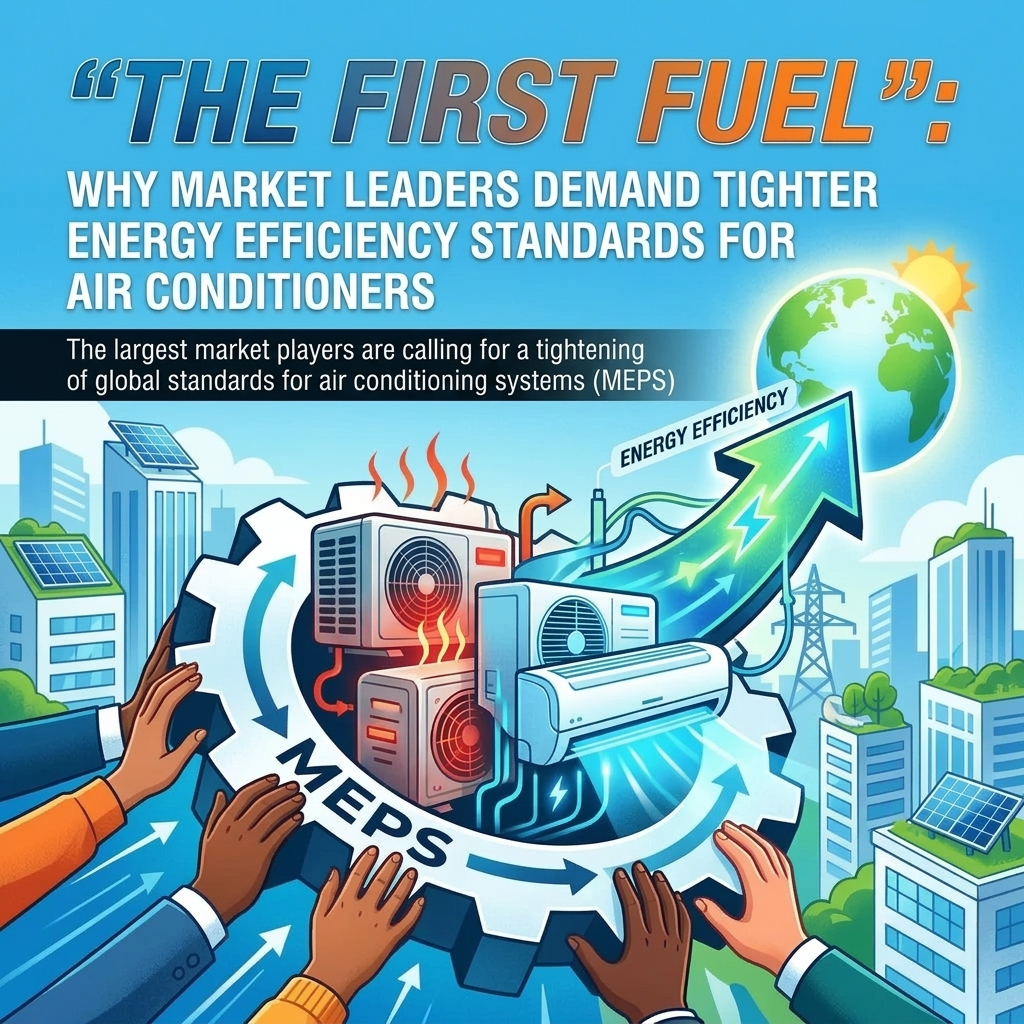
This move is driven by the fact that space cooling has become the fastest-growing source of energy consumption in the building sector. It is also a critical factor in meeting the COP28 commitment to double the rate of energy efficiency improvements by 2030. In other words, this is not merely an initiative by individual manufacturers; it is an effort to integrate the climate agenda into concrete regulatory mechanisms—the very mechanisms that determine which equipment is permitted to enter the market.
The rationale behind the appeal
The appeal is anchored in a set of "Global Policy Principles" developed by the coalition, which comprises over 100 companies and organizations. While the document serves as a high-level framework, it is significant for the industry because it translates broad discussions about sustainability into practical, actionable requirements—covering equipment, buildings, data, and financing.
For professionals in the HVACR (heating, ventilation, air conditioning, and refrigeration) sector, several points are particularly relevant, each with direct implications for operational processes:
Stricter MEPS and building codes. The coalition advocates for the production and use of equipment with the highest energy efficiency ratings, as well as the implementation of "Enhanced Energy Codes" for buildings. This directly impacts the markets for air conditioning systems, industrial cooling, refrigeration equipment, and lighting. The practical implication here is straightforward: as minimum standards are raised, lower-tier equipment is gradually pushed out of the market, compelling designers and procurers to shift toward more advanced models. At the same time, more rigorous building codes establish requirements for the structure as a whole—encompassing its building envelope, mechanical and electrical systems, and operational parameters.
Energy management and data transparency. This involves implementing regular energy audits and energy management systems to identify areas of inefficient energy consumption. While often viewed as a secondary concern, this step actually yields quick results: before replacing equipment, it is essential to understand where and why energy is being wasted. Data transparency is not an end in itself, but a tool—without measurable metrics, any modernization decisions remain mere guesswork.
Circularity and modernization. The coalition promotes the principles of a circular economy, deep building renovation, and the modernization of technical systems rather than their complete replacement. For the industry, this represents a shift toward service-based models, repairs, and component upgrades, moving beyond the simple sale of new equipment. While this approach requires a different skill set and a new way of organizing work, it significantly reduces the overall resource intensity of the construction sector.
Increased funding. A key priority is the need to boost investment in energy efficiency to $1.5 trillion annually in order to meet climate commitments. As the authors of the document point out, without such funding, even the most sophisticated standards will remain nothing more than a declaration; modernization requires capital, and the question of where that funding comes from is just as critical as the technology itself.
Figures Cited by the Coalition
The coalition points to data from the International Energy Agency (IEA): to meet net-zero emissions targets by 2050, the average energy consumption of appliances must fall by 25% by 2030 compared to 2020 levels, while new buildings must reduce the energy used for heating and cooling by 50%. These benchmarks establish a frame of reference—illustrating the significant gap between current practices and the required outcomes—and explain why coalition members insist on the urgent need for action.
The Companies’ Stance
Executives from the companies within the coalition state their position quite bluntly. "For our industry, energy efficiency is not an option; it is the 'first fuel'—the foundation for both competitiveness and decarbonization," noted Sara Vad Sørensen, Vice President and Head of Public Affairs at Danfoss. This framing is significant: energy efficiency is viewed not as a burden on business, but as a resource that replaces a portion of traditional fuel while simultaneously bolstering a company’s reputation and market standing.
"Energy efficiency is not a question—it’s a necessity. It is what we need to pave the way toward a future where all energy is clean," emphasized Anke Hampel, Head of Sustainability at ABB. In this statement, the focus shifts from economics to climate logic: efficiency is framed as a prerequisite for the transition to clean energy, rather than as an end in itself. Despite their differences, both statements point to the same conclusion: the industry views the tightening of requirements as inevitable and prefers to participate in shaping the rules rather than merely reacting to them after the fact.
What this means for engineers and managers
The global trend toward stricter energy efficiency requirements is becoming a regulatory reality. Engineers and managers must align with advanced MEPS (Minimum Energy Performance Standards), implement systematic energy management, and prepare for a transition to energy-efficient technologies.
In practice, this entails several sequential steps. First, when designing or procuring equipment, it is prudent to incorporate requirements that may become mandatory in the coming years, rather than settling for current minimum standards. Second, establishing an energy consumption monitoring system is essential—without it, one cannot justify upgrades or evaluate their impact. Third, it is worth re-evaluating the approach to renovation: upgrading individual systems and components is increasingly proving more rational than complete replacement, and the logic behind regulations is shifting in the same direction.
Finally, the human resources aspect is significant. Transitioning to stricter standards requires expertise in energy auditing, system optimization, and data analysis—areas traditionally considered auxiliary within the industry, but which are now moving to the forefront.
In lieu of a conclusion
The appeal from the Smart Energy Coalition is not merely a lobbying document; it serves as a fairly accurate indicator of industry sentiment. Major equipment manufacturers are effectively acknowledging that future market growth will not be driven by increasing sales volume at any cost, but rather by enhancing the efficiency of both existing and newly installed systems. For HVACR professionals, this signifies a shift in priorities: the focus moves away from the individual specifications of a piece of equipment toward how the entire system functions within a building—and how its operation aligns with climate commitments. As requirements become more stringent, it is best to prepare in advance—using calculations, data, and the understanding that the "first fuel" (energy) is only used efficiently when such efficiency is built into the design from the start.




Major market players are calling for stricter global energy efficiency standards for air conditioning systems. Leading international companies—including Danfoss, Johnson Controls, and ABB—have issued a joint appeal to global policymakers under the banner of the "Smart Energy Coalition." Their primary demand is an urgent tightening of Minimum Energy Performance Standards (MEPS) for both residential and commercial air conditioning systems.
In December 2025, Copeland—a global leader in compressor manufacturing—unveiled a new development: a CO₂ scroll compressor featuring Dynamic Vapor Injection (DVI) technology. This milestone marked a significant step in the evolution of industrial refrigeration equipment, as the combination of the natural refrigerant CO₂ and an advanced vapor injection system opens up new possibilities for enhancing energy efficiency, reducing operating costs, and meeting environmental regulations.
 Выберите размер контейнера: Температурный режим: Новый или Б/У: | Прайс-лист на рефрижераторные контейнеры Вы выбрали: 40 футовые, низкотемпературные, новые 
| ||||||||||||||||||||||||||||||||||||||||||||||||||||




 Telegram